English
 Español
 tiếng việt
 русский
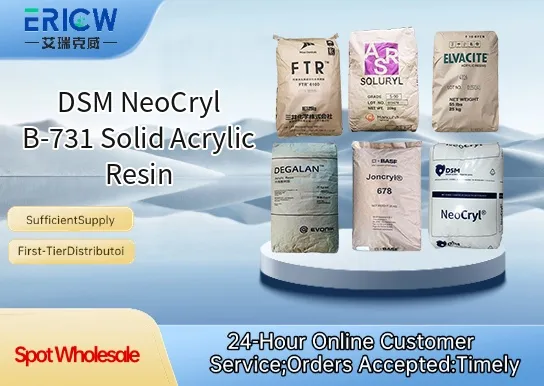
High molecular weight solid acrylic resin offering excellent film-forming capability and hardness development.
Designed for solvent-based systems with good compatibility with common organic solvents and plasticizers.
Delivers outstanding UV resistance and long-term color stability in demanding outdoor applications.
Provides balanced flexibility and scratch resistance without requiring external crosslinkers.
Low volatile organic content (VOC) profile supports formulation compliance with stringent environmental regulations.
Automotive refinish clearcoats and basecoat binders.
Industrial maintenance coatings for metal and concrete substrates.
High-performance coil coatings requiring durability and gloss retention.
Architectural solvent-borne topcoats for façade and cladding systems.
Specialty printing inks requiring rub resistance and substrate adhesion.
| Chemical Type | Thermoplastic acrylic copolymer |
| Product Form | Pale yellow to off-white granular solid |
| Appearance | Free-flowing granules, no visible impurities |
| Primary Applications | Solvent-borne industrial and automotive coatings |
| Key Features | High Tg (~105°C), low melt viscosity, excellent clarity |
| Benefits | Enhanced hardness, gloss, and weatherability without curing agents |
| Solubility | Soluble in aromatic hydrocarbons, ketones, and esters |
| Storage Stability | Stable under dry, cool conditions (≤30°C); shelf life ≥24 months |
Q1: What is the primary function of NeoCryl B-731 in coating formulations?
A: NeoCryl B-731 is a solid acrylic resin designed to serve as a film-forming binder and rheology modifier in high-solids, low-VOC solventborne coatings—particularly where enhanced flow, leveling, and substrate wetting are required.
Q2: Is NeoCryl B-731 compatible with common crosslinkers used in industrial baking systems?
A: Yes, NeoCryl B-731 exhibits good compatibility with standard amino resins (e.g., melamine-formaldehyde) and polyisocyanate hardeners, supporting both ambient-cure and thermal-cure applications depending on formulation design.
Q3: How should NeoCryl B-731 be incorporated into a coating system?
A: It is typically added during the let-down stage under moderate agitation, dissolved fully in suitable aromatic or ketonic solvents prior to blending with pigments, additives, and other resins. Pre-dissolution helps ensure uniform dispersion and avoids gelation risks.
Q4: Does NeoCryl B-731 contribute to improved scratch resistance or surface hardness?
A: While not primarily engineered as a hardness enhancer, its acrylic backbone supports balanced film integrity and contributes to improved mar resistance and cohesive strength when properly cured—especially in combination with appropriate crosslinkers and curing conditions.
Contact With Us:
E-mail: wangxingqiang@ericwchem.com
Have a Questions? Call Us:
Add:
Building A1, Jiete Industrial Park, Huangpu District, Guangzhou City, Guangdong Province, China