English
 Español
 tiếng việt
 русский
Highly selective for ethylene oxide hydrolysis to monoethylene glycol (MEG) under mild reaction conditions.
Thermally stable solid catalyst with extended operational lifetime in continuous fixed-bed reactors.
Low metal leaching performance, ensuring consistent product purity and reduced downstream purification burden.
Engineered for excellent resistance to water-induced deactivation and thermal sintering.
Non-toxic, non-corrosive formulation compliant with industrial hygiene and process safety standards.
Production of high-purity monoethylene glycol (MEG) in ethylene oxide hydration units.
Integrated glycol synthesis processes requiring low by-product formation (e.g., diethylene glycol, triethylene glycol).
Modern MEG plants upgrading from acid-catalyzed or thermal hydration to heterogeneous catalytic technology.
On-purpose glycol manufacturing for electronics-grade and pharmaceutical excipient applications.
Energy-efficient retrofit solutions for existing EO hydration facilities seeking improved selectivity and catalyst longevity.
| Chemical Type | Heterogeneous solid acid catalyst based on modified silica-alumina matrix |
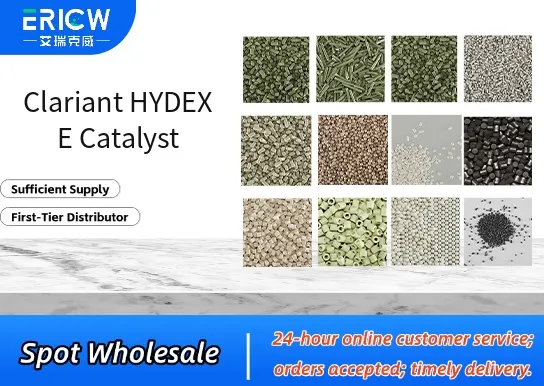
| Product Form | Free-flowing cylindrical extrudates (3 mm diameter × 4–6 mm length) |
| Appearance | Off-white to light tan granular solid |
| Primary Applications | Catalytic hydration of ethylene oxide to monoethylene glycol (MEG) |
| Key Features | High MEG selectivity (>95%), low DEG/TEG co-production, water-tolerant active sites |
| Benefits | Reduced energy consumption, extended catalyst cycle life (>24 months), simplified waste handling |
| Storage Conditions | Store in dry, well-ventilated area; protect from moisture and direct sunlight |
| Handling Precautions | Use standard industrial PPE; avoid inhalation of dust during loading/unloading |
Q1: What is the primary function of HYDEX E Catalyst in polymer processing?
A: HYDEX E Catalyst is a highly efficient, metal-free catalyst designed to accelerate epoxy–anhydride crosslinking reactions—particularly in thermosetting resin systems for composites, encapsulants, and high-performance coatings. It promotes rapid gelation and full cure at moderate temperatures while supporting excellent storage stability in formulated resins.
Q2: Is HYDEX E Catalyst compatible with common epoxy resins and anhydride hardeners?
A: Yes—HYDEX E Catalyst demonstrates broad compatibility with standard bisphenol-A and bisphenol-F epoxies, as well as widely used anhydride hardeners such as methylhexahydrophthalic anhydride (MHHPA), hexahydrophthalic anhydride (HHPA), and nadic methyl anhydride (NMA). Compatibility should always be verified under actual formulation and processing conditions.
Q3: How is HYDEX E Catalyst typically dosed in epoxy–anhydride systems?
A: Dosage is formulation-dependent but generally ranges from 0.1% to 2% by weight relative to the total resin solids. Optimal loading balances reactivity, pot life, and final network properties—and is best determined through small-scale cure profiling and rheological testing.
Q4: Does HYDEX E Catalyst require special handling or storage conditions?
A: HYDEX E Catalyst should be stored in its original sealed container at room temperature, protected from moisture and direct sunlight. While it is not classified as hazardous for transport under current GHS criteria, good industrial hygiene practices—including avoiding inhalation of dust and contact with skin or eyes—are recommended during handling.
Contact With Us:
E-mail: wangxingqiang@ericwchem.com
Have a Questions? Call Us:
Add:
Building A1, Jiete Industrial Park, Huangpu District, Guangzhou City, Guangdong Province, China