English
 Español
 tiếng việt
 русский
Highly selective for styrene production via ethylbenzene dehydrogenation.
Enhanced thermal stability enabling extended catalyst cycle life and reduced shutdown frequency.
Low coke formation tendency, maintaining consistent activity over long operational periods.
Optimized for use in adiabatic and pseudo-adiabatic reactor configurations.
Environmentally compatible formulation with low heavy metal content and minimal leaching risk.
Styrene monomer (SM) manufacturing plants using conventional steam-heated dehydrogenation units.
Integrated petrochemical complexes requiring high-yield, low-energy styrene synthesis.
Retrofit applications for upgrading legacy catalyst systems to improve conversion and selectivity.
Greenfield styrene facilities designed for energy efficiency and CO₂ emission reduction.
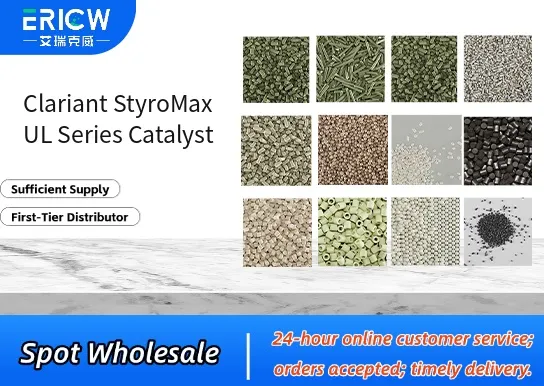
| Chemical Type | Iron oxide–potassium–cerium–chromium promoted catalyst |
| Product Form | Extruded cylindrical pellets (5 mm diameter × 5–10 mm length) |
| Appearance | Dark brown to black granular solid |
| Primary Applications | Ethylbenzene dehydrogenation to styrene under industrial conditions |
| Key Features | High selectivity (>90%), low steam-to-hydrocarbon ratio operation, robust mechanical strength |
| Benefits | Reduced energy consumption, lower operating costs, improved product purity, extended run length |
| Storage Requirement | Store in dry, ventilated area; protect from moisture and mechanical damage |
Q1: What is the primary function of the StyroMax UL Series in styrenic polymer processing?
A: The StyroMax UL Series is a high-performance catalyst designed to enhance thermal stability and promote efficient crosslinking or controlled degradation during the processing of styrenic polymers—particularly in applications requiring low volatility, reduced odor, and improved melt consistency.
Q2: Is StyroMax UL compatible with food-contact-grade polystyrene or ABS formulations?
A: StyroMax UL Series catalysts are formulated for use in high-purity styrenic systems and have been evaluated for suitability in certain food-contact applications; however, final regulatory compliance depends on the full formulation, processing conditions, and applicable regional requirements—validation testing by the compounder is recommended.
Q3: How does StyroMax UL differ from conventional peroxide-based catalysts in styrenic systems?
A: Unlike traditional peroxides, StyroMax UL Series offers improved thermal latency and lower volatility, enabling better process control during extrusion or molding. It delivers consistent catalytic activity with reduced odor generation and minimal impact on polymer color or long-term stability.
Q4: What is the typical dosage range for StyroMax UL Series in industrial compounding?
A: Dosage is formulation-dependent but generally ranges from 0.1% to 2% by weight relative to the base polymer. Optimal loading is determined through application-specific trials to balance reactivity, rheology, and final product performance.
Contact With Us:
E-mail: wangxingqiang@ericwchem.com
Have a Questions? Call Us:
Add:
Building A1, Jiete Industrial Park, Huangpu District, Guangzhou City, Guangdong Province, China