English
 Español
 tiếng việt
 русский
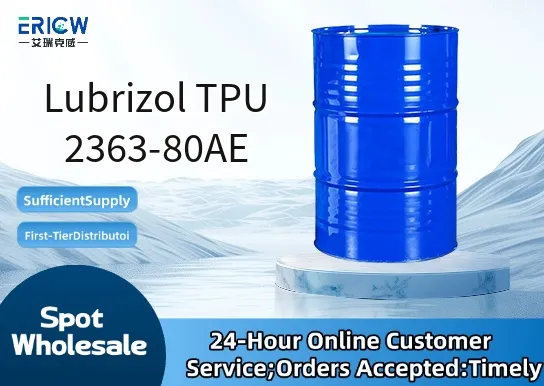
Excellent abrasion resistance for demanding mechanical environments.
Outstanding low-temperature flexibility down to –40 °C.
Good oil and grease resistance suitable for industrial fluid contact.
High tensile strength and elongation retention after thermal aging.
Processable via standard thermoplastic methods including extrusion and injection molding.
Automotive interior trim components requiring soft-touch feel and durability.
Industrial hoses and tubing exposed to dynamic flexing and mild hydrocarbons.
Consumer electronics protective casings with impact absorption and aesthetic clarity.
Medical device housings compliant with ISO 10993 biocompatibility screening requirements.
Footwear midsoles and outsoles needing rebound resilience and weather resistance.
| Chemical Type | Aliphatic polyester-based thermoplastic polyurethane |
| Product Form | Pellets |
| Appearance | Off-white, free-flowing granules |
| Hardness (Shore A) | 80 ± 2 |
| Density (g/cm³) | 1.18–1.20 |
| Melt Flow Rate (230 °C/2.16 kg, g/10 min) | 12–16 |
| Primary Applications | Extruded profiles, injection-molded parts, overmolding substrates |
| Key Features | Abrasion resistance, low-temp flexibility, processability, chemical resilience |
Q1: What is the primary function of Lubrizol TPU 2363-80AE in thermoplastic polyurethane (TPU) formulations?
A: Lubrizol TPU 2363-80AE is a high-performance processing aid and melt-flow modifier specifically engineered for TPU compounds. It improves melt homogeneity, reduces extrusion torque, and enhances surface finish—particularly in demanding applications such as thin-wall injection molding and fine-gauge film extrusion.
Q2: Is Lubrizol TPU 2363-80AE compatible with all major TPU chemistries (e.g., polyester-, polyether-, and polycaprolactone-based TPUs)?
A: Yes, it demonstrates broad compatibility across common TPU base resins, including aromatic and aliphatic variants. Compatibility testing under actual processing conditions is recommended to optimize dispersion and performance for specific resin grades and end-use requirements.
Q3: How should Lubrizol TPU 2363-80AE be incorporated into a TPU compound?
A: It is typically introduced during compounding via twin-screw extrusion, either as a masterbatch or direct feed. Pre-drying is not required, but uniform feeding and adequate residence time are essential to ensure complete dispersion and avoid localized agglomeration.
Q4: Does Lubrizol TPU 2363-80AE affect the mechanical properties or clarity of finished TPU parts?
A: When used at typical dosage levels, it generally maintains key mechanical performance—including tensile strength, elongation, and tear resistance—while improving processability. In transparent TPU systems, it does not introduce haze or yellowing when properly dispersed and processed within recommended thermal limits.
Contact With Us:
E-mail: wangxingqiang@ericwchem.com
Have a Questions? Call Us:
Add:
Building A1, Jiete Industrial Park, Huangpu District, Guangzhou City, Guangdong Province, China