English
 Español
 tiếng việt
 русский
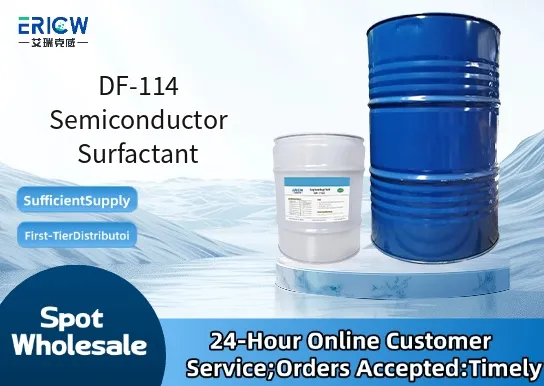
Ultra-low ionic residue for minimal metal ion contamination in critical cleaning and rinse processes.
Exceptional wetting and penetrating performance on hydrophobic semiconductor surfaces (e.g., SiO₂, SiNₓ, photoresist).
Thermally stable up to 120 °C, supporting high-temperature wafer processing and drying steps.
Non-foaming formulation optimized for megasonic and spray-based tool integration.
Readily biodegradable under OECD 301F conditions, aligning with green manufacturing initiatives.
Post-etch residue removal for advanced logic and memory device fabrication (≤5 nm nodes).
Photoresist stripping and sidewall polymer clean in BEOL interconnect modules.
Pre-deposition surface conditioning prior to ALD/CVD of high-k dielectrics and barrier layers.
Wafer-level packaging (WLP) cleaning for copper pillar and microbump interfaces.
Final rinse additive in deionized water (DIW) systems to suppress particle redeposition.
| Chemical Type | Nonionic surfactant blend (ethoxylated alkylphenol-free) |
| Product Form | Aqueous concentrate (30 wt% active) |
| Appearance | Clear, colorless to pale yellow liquid |
| pH (1% aqueous solution, 25 °C) | 6.8 – 7.2 |
| Primary Applications | Wafer cleaning, residue removal, DIW rinse enhancement |
| Key Features | Low volatility, non-corrosive to Cu/Al/low-k dielectrics, halogen-free |
| Benefits | Reduces defect density (≥30% vs. conventional surfactants), improves yield in 300 mm wafer lines |
| Regulatory Compliance | REACH SVHC-free, RoHS 2015/863 compliant, no listed PFAS substances |
| Common Compatible Systems | Suitability |
| SEZ™ and Tokyo Electron (TEL) SC2-based cleaning tools | Highly Recommended – Validated for inline use with <1 ppb metal leaching |
| Applied Materials Centura® and Producer® platforms | Recommended – Requires dilution optimization; compatible with chamber materials (quartz, silicon carbide) |
| DIW rinse modules (Lam Research, SCREEN, DNS) | Highly Recommended – Proven efficacy at 0.05–0.2 vol% concentration |
| Batch-type ultrasonic cleaners (200–800 kHz) | Suitable – Effective with temperature control ≤60 °C to prevent foaming |
Q1: What is the CAS Registry Number for DF-114?
A: DF-114 is a proprietary multi-component formulation; individual CAS numbers are confidential per trade secret protection. Full compositional disclosure is available under NDA for qualified customers.
Q2: What is the recommended working concentration range?
A: Typical dosage is 0.02–0.3 vol% in DIW or process chemistries. Optimal concentration depends on tool type, substrate, and contaminant load—validation via particle count (KLA-Tencor) and surface analysis (XPS/TOF-SIMS) is advised.
Q3: How does DF-114 compare to traditional alkylphenol ethoxylates (APEOs) in semiconductor applications?
A: DF-114 contains zero APEOs and offers superior low-volatility residue control, lower ecotoxicity (LC50 >100 mg/L, Daphnia magna), and enhanced compatibility with copper metallization—unlike legacy APEOs, which risk galvanic corrosion and EU regulatory noncompliance.
Q4: Has DF-114 been tested for extractables and leachables in contact with fluoropolymer wetted parts (e.g., PFA, FEP)?
A: Yes. Extractables testing per USP <87> and <88> confirms <0.5 µg/cm² total organic carbon (TOC) leaching from PFA tubing after 72 h exposure at 60 °C — well below industry acceptance thresholds for front-end process chemicals.
Q5: Is DF-114 certified for use in ISO Class 1 cleanrooms?
A: DF-114 is manufactured and packaged in ISO Class 5 (Class 100) environments. Certificate of Analysis includes particle count data (≤1 particle/mL ≥0.2 µm per ASTM F50) and endotoxin levels (<0.03 EU/mL).
Contact With Us:
E-mail: wangxingqiang@ericwchem.com
Have a Questions? Call Us:
Add:
Building A1, Jiete Industrial Park, Huangpu District, Guangzhou City, Guangdong Province, China