English
 Español
 tiếng việt
 русский
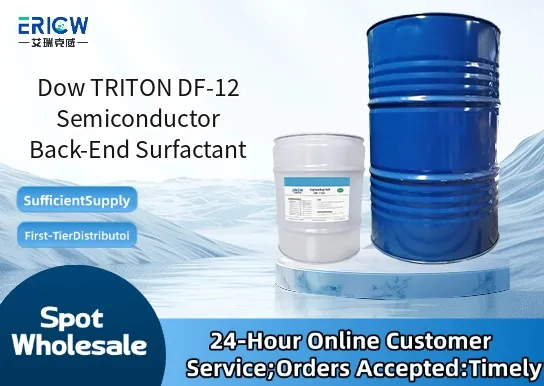
Ultra-low ionic residue profile optimized for post-CMP and wafer cleaning in advanced packaging and back-end-of-line (BEOL) processes.
Exceptional surface tension reduction without compromising particle removal efficiency or interfacial stability in DI water-based chemistries.
High thermal and hydrolytic stability under typical semiconductor rinse and dry conditions (20–80 °C, pH 5–8).
Non-silicon-containing formulation to prevent dielectric contamination and ensure compatibility with low-k materials.
Controlled surfactant architecture enabling rapid, uniform drying and minimized watermark formation on patterned wafers.
Post-chemical mechanical polishing (post-CMP) rinse additives for copper/low-k interconnect structures.
Wafer-level packaging (WLP) cleaning formulations for fan-out and 2.5D/3D integration processes.
Back-end-of-line (BEOL) wet cleaning steps prior to dielectric capping or metallization.
Advanced substrate cleaning for high-density interposers and silicon photonics platforms.
Low-residue rinse aids in single-wafer spin-rinse-dry (SRD) and batch megasonic systems.
| Chemical Type | Nonionic ethoxylated alkylphenol derivative (branched C9–C11 alkyl chain, ~12 EO units) |
| Product Form | Clear, colorless to pale yellow liquid |
| Appearance | Homogeneous liquid at 25 °C; no phase separation |
| pH (1% aqueous solution, 25 °C) | 6.0 – 7.5 |
| Primary Applications | BEOL rinse aid, post-CMP additive, low-k compatible surfactant |
| Key Features | Low volatility, non-foaming, ultra-low sodium/potassium/chloride content (<1 ppm by ICP-MS) |
| Benefits | Reduces surface energy for uniform drying; minimizes microdroplet retention and watermark defects |
| Regulatory Compliance | REACH registered; RoHS 2 Directive compliant; no SVHCs above threshold per current ECHA list |
| Common Compatible Systems | Suitability |
| DI Water-based spin-rinse-dry (SRD) tools | Highly Recommended – Demonstrated compatibility with Lam RAINBOW®, Tokyo Electron ACTRION®, and SCREEN Dainippon SSW systems |
| Megasonic cleaning baths (200–1000 kHz) | Recommended – Stable performance with minimal degradation under ultrasonic energy |
| Low-k dielectric etch-stop layer rinses (e.g., SiCOH, porous silica) | Highly Recommended – No measurable leaching or hydrophobicity shift after exposure |
| Copper barrier film (Ta/TaN, Co, Ru) rinse formulations | Suitable – No observed corrosion or interfacial delamination in accelerated testing (85 °C/85% RH, 96 h) |
Q1: What is the CAS Registry Number for Dow TRITON DF-12?
A: The CAS Registry Number is 68441-17-8 (generic for branched nonylphenol ethoxylates with ~12 EO); product-specific analytical certificate includes lot-specific impurity profiling per SEMI F57 standards.
Q2: What is the recommended dosage range in BEOL rinse formulations?
A: Typical use level is 0.01–0.05 wt% in deionized water; optimal concentration is process- and tool-dependent and should be validated via contact angle measurement and defectivity screening (KLA-Tencor Surfscan).
Q3: How does TRITON DF-12 compare to TRITON X-100 or DF-10 in semiconductor applications?
A: Unlike TRITON X-100 (higher ionic residue, phenol-related extractables), DF-12 features refined branching and tighter EO distribution to reduce volatility and extraction risk; versus DF-10, it offers enhanced thermal stability and lower carbon residue per ASTM E1551 TOC analysis.
Q4: Is TRITON DF-12 compliant with SEMI S2/S8 safety standards and qualified for Class 10 cleanrooms?
A: Yes — certified per SEMI S2-0218 (health & safety) and SEMI S8-0718 (ergonomics); particulate testing confirms <1 particle/cm² (≥0.1 µm) after filtration through 0.02 µm PES membrane per SEMI F39.
Q5: Has migration or leaching into low-k dielectrics been evaluated?
A: Accelerated soak testing (72 h, 65 °C, DI water) followed by TOF-SIMS depth profiling showed no detectable surfactant penetration beyond 2 nm into SiCOH (k=2.7); no change in k-value or leakage current observed per JEDEC JESD22-A108.
Contact With Us:
E-mail: wangxingqiang@ericwchem.com
Have a Questions? Call Us:
Add:
Building A1, Jiete Industrial Park, Huangpu District, Guangzhou City, Guangdong Province, China