English
 Español
 tiếng việt
 русский
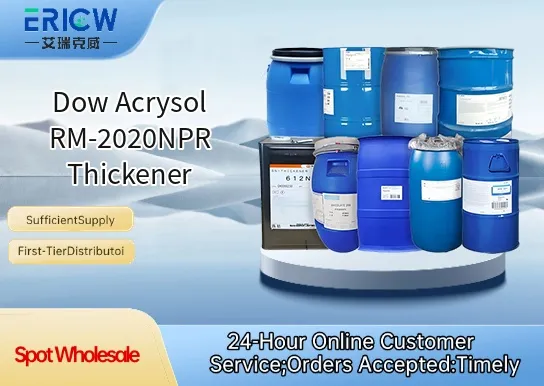
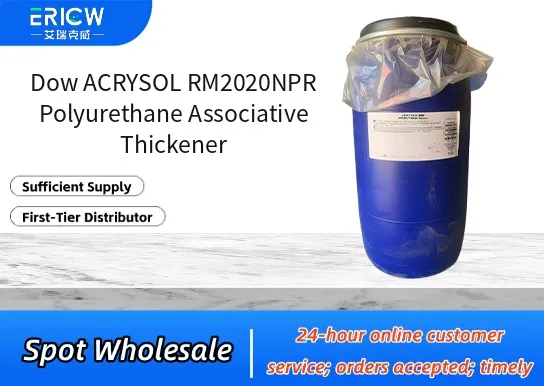
Non-ionic associative thickener offering excellent rheology control in waterborne systems.
Delivers high sag resistance and outstanding leveling performance in architectural coatings.
Provides low-shear viscosity enhancement with minimal impact on high-shear flow behavior.
Compatible with a broad range of anionic and non-ionic surfactants and co-thickeners.
Enables formulation flexibility with good freeze-thaw stability and long-term storage robustness.
Interior and exterior flat and low-sheen architectural paints.
Textured coatings and decorative finishes.
Water-based primers and undercoats.
Industrial maintenance coatings for metal and masonry substrates.
Low-VOC and zero-VOC compliant coating formulations.
| Chemical Type | Non-ionic hydrophobically modified ethoxylated urethane (HEUR) |
| Product Form | Opaque white liquid |
| Appearance | Viscous, milky dispersion |
| pH (1% aqueous solution) | 6.5–8.5 |
| Active Content (wt%) | 20–22% |
| Specific Gravity (25°C) | 1.02–1.06 g/cm³ |
| Solubility | Water-dispersible; insoluble in hydrocarbons and most organic solvents |
| Storage Stability | Stable for ≥12 months at 5–30°C in original sealed container |
Q1: What type of rheology does RM-2020NPR provide in aqueous systems?
A: RM-2020NPR is a hydrophobically modified ethoxylated urethane (HEUR) associative thickener that delivers pseudoplastic (shear-thinning) rheology, offering excellent flow and leveling at low shear while maintaining sag resistance and viscosity stability at rest.
Q2: Is RM-2020NPR compatible with common surfactants and co-solvents used in architectural coatings?
A: Yes — RM-2020NPR exhibits good compatibility with nonionic and anionic surfactants, as well as typical co-solvents such as glycol ethers and alcohols. However, formulation screening is recommended to confirm performance in specific systems containing high levels of ionic surfactants or strong solvents.
Q3: How should RM-2020NPR be incorporated into a water-based formulation?
A: It is typically added during the let-down stage, after pigment dispersion and under moderate agitation. Pre-dilution with water or a compatible solvent may improve dispersion uniformity. Avoid high-shear addition directly to highly ionic or low-pH phases without prior evaluation.
Q4: Does RM-2020NPR require neutralization or pH adjustment for activation?
A: No — unlike alkali-swellable thickeners (ASE), RM-2020NPR is a non-ionic HEUR thickener and does not rely on pH for thickening performance. Its associative mechanism functions across a broad pH range (typically pH 4–10), though extreme pH values may affect long-term stability.
Q5: What are key handling and storage considerations for RM-2020NPR?
A: Store in original sealed containers at temperatures between 5°C and 30°C, protected from freezing and prolonged exposure to direct sunlight. Avoid contamination with incompatible materials; always follow Dow’s Safety Data Sheet (SDS) for safe handling, personal protection, and disposal guidance.
Contact With Us:
E-mail: wangxingqiang@ericwchem.com
Have a Questions? Call Us:
Add:
Building A1, Jiete Industrial Park, Huangpu District, Guangzhou City, Guangdong Province, China