English
 Español
 tiếng việt
 русский
High hydroxyl functionality for excellent crosslink density with melamine and polyisocyanate curing agents.
Optimized molecular weight distribution for superior flow, leveling, and gloss development in high-solids coatings.
Low viscosity at high solids content, enabling reduced solvent demand and improved VOC compliance.
Excellent compatibility with common acrylics, alkyds, and polyester resins in hybrid coating systems.
Robust weathering resistance and UV stability for long-term exterior performance.
Automotive OEM topcoats and clearcoats.
Industrial maintenance coatings for metal substrates.
General-purpose high-performance coil coatings.
Powder coating hybrids requiring hydroxyl functionality.
Refinish coatings requiring fast cure and high durability.
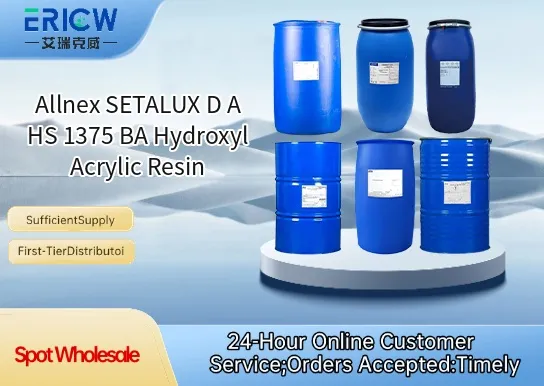
| Chemical Type | Hydroxyl-functional acrylic resin |
| Product Form | Liquid solution in aromatic hydrocarbons and esters |
| Appearance | Clear, pale yellow liquid |
| Solids Content (wt%) | ~60% (as supplied) |
| Hydroxyl Value (mg KOH/g) | 85–95 |
| Acid Value (mg KOH/g) | < 5 |
| Viscosity (mPa·s, 25°C) | 4,000–6,000 |
| Primary Applications | OEM automotive, industrial coatings, coil coatings |
Q1: What is the primary function of SETALUX D A HS 1375 BA in coating formulations?
A: SETALUX D A HS 1375 BA serves as a hydroxyl-functional acrylic resin designed to act as a reactive binder in two-component polyurethane and polyester-based systems. It contributes to film formation, hardness development, gloss retention, and chemical resistance upon crosslinking with isocyanate curing agents.
Q2: Is this resin compatible with common aliphatic isocyanate crosslinkers?
A: Yes, SETALUX D A HS 1375 BA is formulated for compatibility with standard aliphatic polyisocyanates, including HDI-based trimer and biuret types. It enables robust cure profiles under ambient or forced-dry conditions while supporting excellent UV stability and color retention in high-performance topcoats.
Q3: How does this resin perform in high-solids coating systems?
A: SETALUX D A HS 1375 BA is engineered for high-solids applications, offering favorable viscosity characteristics and good flow/leveling behavior without excessive solvent demand. Its molecular architecture supports reduced VOC content while maintaining application efficiency and final film integrity.
Q4: Can it be used in automotive refinish or OEM clearcoats?
A: Yes — this resin is widely employed in demanding decorative and protective coatings, including automotive refinish clearcoats and select OEM trim coatings, where high gloss, scratch resistance, and long-term weatherability are required. Performance validation is recommended within the specific formulation matrix.
Contact With Us:
E-mail: wangxingqiang@ericwchem.com
Have a Questions? Call Us:
Add:
Building A1, Jiete Industrial Park, Huangpu District, Guangzhou City, Guangdong Province, China