English
 Español
 tiếng việt
 русский
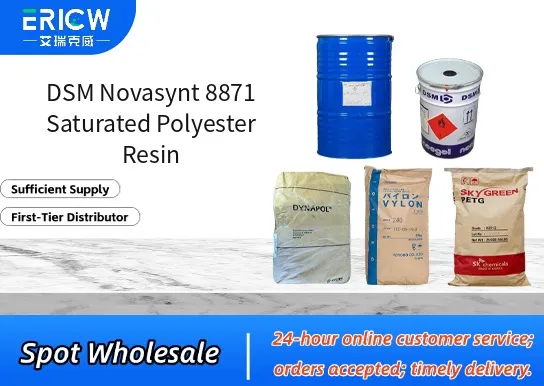
High chemical resistance to solvents, acids, and alkalis for demanding industrial environments.
Excellent UV stability and weatherability, supporting long-term outdoor performance.
Low viscosity enabling easy handling, efficient pigment dispersion, and high-solids formulation flexibility.
Non-yellowing profile suitable for premium clearcoats and light-colored topcoats.
Compatible with melamine formaldehyde crosslinkers for thermoset coatings with balanced cure response.
Automotive OEM and refinish clearcoats.
Industrial maintenance coatings for metal substrates.
Architectural coil coatings requiring durability and gloss retention.
Powder coating base resins for indoor and outdoor applications.
General-purpose high-performance decorative and protective topcoats.
| Chemical Type | Saturated polyester resin |
| Product Form | Clear, viscous liquid |
| Appearance | Colorless to pale yellow, transparent |
| Primary Applications | Thermoset coatings, clearcoats, coil coatings, powder coatings |
| Key Features | Low yellowing, high weather resistance, melamine-compatible |
| Benefits | Enhanced gloss retention, excellent substrate adhesion, low VOC potential |
| Storage Conditions | Store in cool, dry place below 30°C; protect from freezing |
| Shelf Life | 12 months from date of manufacture under recommended conditions |
Q1: What is the primary application area for Novasynt 8871?
A: Novasynt 8871 is specifically designed as a binder resin for high-performance powder coatings, particularly where excellent flow, gloss retention, and mechanical durability are required—commonly used in architectural, appliance, and general industrial coating systems.
Q2: How does Novasynt 8871 compare to conventional saturated polyesters in terms of curing behavior?
A: Novasynt 8871 exhibits balanced reactivity with standard TGIC and hydroxyalkylamide (HAA) hardeners, enabling reliable cure profiles across typical industrial oven conditions. Its molecular design supports consistent crosslink density without excessive sensitivity to minor temperature or time variations.
Q3: Is Novasynt 8871 suitable for low-cure or energy-efficient formulations?
A: Yes—Novasynt 8871 demonstrates good reactivity at reduced cure temperatures (e.g., 160–180 °C), making it well-suited for formulations targeting lower energy consumption, provided compatible hardeners and catalysts are selected.
Q4: What are the recommended storage conditions?
A: Store in original sealed containers in a cool, dry place away from direct sunlight and sources of heat. Prolonged exposure to elevated ambient temperatures or humidity may affect handling properties and shelf life.
Q5: Can Novasynt 8871 be blended with other polyester resins or acrylics?
A: It can be co-formulated with select complementary saturated polyesters or acrylic resins to fine-tune performance attributes such as flexibility, UV resistance, or surface hardness—however, compatibility testing is strongly recommended prior to full-scale implementation.
Contact With Us:
E-mail: wangxingqiang@ericwchem.com
Have a Questions? Call Us:
Add:
Building A1, Jiete Industrial Park, Huangpu District, Guangzhou City, Guangdong Province, China