English
 Español
 tiếng việt
 русский
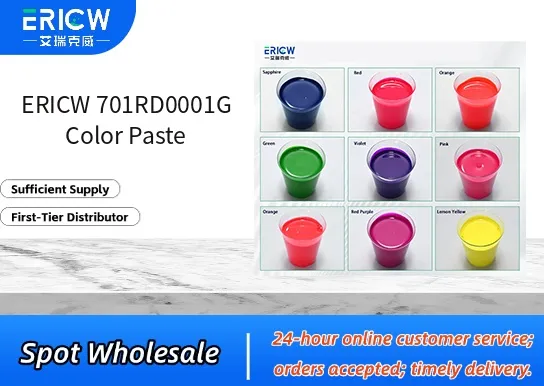
High chroma red pigment dispersion with excellent color strength and consistency.
Optimized for compatibility with water-based acrylic, polyurethane, and epoxy resin systems.
Low volatile organic compound (VOC) content, supporting sustainable formulation requirements.
Excellent storage stability—no significant sedimentation or viscosity drift after 12 months at 25°C.
Good lightfastness and thermal stability up to 180°C for short-term processing conditions.
Architectural and industrial waterborne coatings.
Automotive refinish basecoats and clearcoat tints.
Plastic color concentrates for injection molding and extrusion.
Wood finishes including stains, lacquers, and UV-curable coatings.
Printing inks for flexible packaging and label applications.
| Chemical Type | Organic red pigment dispersion (P.R. 254-based) |
| Product Form | Viscous liquid paste |
| Appearance | Uniform dark red paste, free from grit or lumps |
| Primary Applications | Water-based and solvent-borne coatings, plastics, inks |
| Key Features | High tinting strength, low VOC, good rheology control |
| Benefits | Reduced formulation complexity, improved batch-to-batch reproducibility |
| Recommended Diluent | Deionized water or compatible glycol ether blends |
| Shelf Life | 12 months in unopened original container at 5–30°C |
Q1: What types of polymer systems is ERICW 701RD0001G Color Paste compatible with?
A: ERICW 701RD0001G is formulated for compatibility with common thermoplastic resins including polyolefins (PP, PE), PS, ABS, and certain engineering plastics. Performance in specific matrices should be verified through lab-scale dispersion and stability testing.
Q2: How should this color paste be incorporated into a production process?
A: It is typically introduced via gravimetric or volumetric dosing directly into the extruder feed throat or compounder, or pre-blended with base resin using high-shear mixing. Good dispersion requires adequate melt temperature, residence time, and mechanical energy input.
Q3: Is ERICW 701RD0001G suitable for applications requiring regulatory compliance for food contact or toys?
A: This grade is not pre-certified for regulated end uses. Customers must evaluate its suitability against applicable regional requirements—including migration behavior, extractables, and intended use conditions—using their own qualified testing protocols and regulatory support documentation.
Q4: What is the recommended storage condition to maintain product stability?
A: Store in original sealed containers at temperatures between 5°C and 30°C, away from direct sunlight and sources of heat or moisture. Avoid freezing, and ensure lids are tightly closed after each use to prevent skinning or viscosity changes.
Contact With Us:
E-mail: wangxingqiang@ericwchem.com
Have a Questions? Call Us:
Add:
Building A1, Jiete Industrial Park, Huangpu District, Guangzhou City, Guangdong Province, China