English
 Español
 tiếng việt
 русский
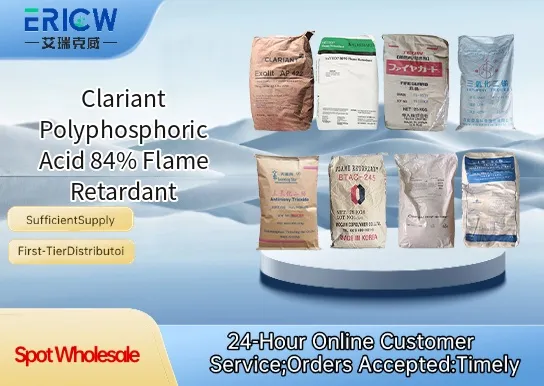
Highly effective condensed-phase flame retardant based on polyphosphoric acid chemistry.
Enables excellent char formation and thermal stability in polymer matrices during combustion.
Low volatility and high phosphorus content (≥75% P₂O₅ equivalent) for efficient flame suppression.
Compatible with engineering thermoplastics including polyesters, polyamides, and polyolefin blends.
Non-halogenated formulation supporting regulatory compliance and sustainable material design.
Flame-retardant polybutylene terephthalate (PBT) for automotive connectors and E&E housings.
Enhanced fire performance in glass-fiber-reinforced polyamide 6 and PA66 compounds.
Intumescent systems for rigid polyurethane foams used in building insulation.
Flame-retardant masterbatches for injection-molded consumer electronics components.
| Chemical Type | Polyphosphoric acid (PPA), mixture of ortho-, pyro-, and metaphosphoric acids |
| Product Form | Viscous liquid |
| Appearance | Colorless to pale yellow, clear to slightly hazy liquid |
| Phosphorus Content (as P₂O₅) | ≥75.0 wt% |
| Acidity (as H₃PO₄) | ≥84.0 wt% |
| Density (20°C) | ~1.80–1.90 g/cm³ |
| Viscosity (25°C) | 1,500–3,000 mPa·s |
| Primary Applications | Condensed-phase flame retardant for thermoplastics and intumescent coatings |
Q1: What is the primary mechanism of flame retardancy for this polyphosphoric acid product?
A: Clariant Polyphosphoric Acid 84% functions primarily through condensed-phase action, promoting char formation on the polymer surface during thermal decomposition. This protective char layer insulates the underlying material, reduces fuel release, and limits heat feedback to the flame zone.
Q2: In which polymer systems is this product most commonly used?
A: It is widely applied in thermosetting resins such as phenolics, epoxies, and unsaturated polyesters, particularly where enhanced fire performance is required without significantly compromising mechanical integrity or processability. Its compatibility with aromatic-rich matrices makes it especially suitable for rigid foams and laminates.
Q3: How does the 84% concentration affect handling and formulation stability?
A: The 84% concentration offers a favorable balance between reactivity and viscosity—sufficiently fluid for homogeneous dispersion in resin systems while maintaining high phosphorus content for effective flame inhibition. Users should ensure adequate mixing energy and avoid prolonged exposure to ambient moisture during processing to preserve consistency.
Q4: Is this product compatible with common curing agents and additives?
A: Yes—it demonstrates good compatibility with conventional amine and anhydride hardeners, as well as many fillers and pigments used in flame-retardant composites. However, pre-formulation compatibility testing is recommended when combining with highly basic or strongly reducing additives to prevent premature viscosity changes or gas evolution.
Q5: What are typical dosage guidelines for achieving V-0 rating in UL 94 tests?
A: Dosage depends on the base polymer, filler system, and part geometry—but in optimized phenolic or epoxy formulations, effective flame retardancy (including UL 94 V-0) is typically achieved at loadings ranging from 0.1% to 2% by weight. Final optimization requires empirical evaluation under actual processing and test conditions.
Contact With Us:
E-mail: wangxingqiang@ericwchem.com
Have a Questions? Call Us:
Add:
Building A1, Jiete Industrial Park, Huangpu District, Guangzhou City, Guangdong Province, China