English
 Español
 tiếng việt
 русский
Broad-spectrum fungicidal activity against key ascomycete and basidiomycete pathogens, including Botrytis, Alternaria, and Rhizoctonia species.
Systemic + translaminar mode of action ensures both protective and curative efficacy with extended residual control.
Low mammalian toxicity profile (EPA Category III) and favorable environmental fate characteristics supporting sustainable use.
Compatible with integrated pest management (IPM) programs and demonstrates no cross-resistance to major FRAC Group 1, 3, or 7 fungicides.
Stable in tank mixtures with common insecticides, growth regulators, and foliar nutrients under standard application conditions.
Greenhouse and high-tunnel production of tomatoes, cucumbers, and peppers.
Field-grown strawberries and soft fruit crops susceptible to gray mold and anthracnose.
Nursery stock and ornamental bedding plants in propagation and finishing stages.
Protected lettuce and leafy greens grown under plastic mulch or row covers.
Seedling trays and plug production in commercial horticultural facilities.
| Chemical Type | Triazole-class systemic fungicide (active ingredient: cyproconazole) |
| Product Form | Emulsifiable concentrate (EC) |
| Appearance | Amber to light brown clear liquid |
| Active Ingredient Concentration | 100 g/L cyproconazole |
| Primary Applications | Foliar spray for pre- and post-infection disease control |
| Key Features | Translaminar movement, rainfastness >4 hours, UV-stabilized formulation |
| Benefits | Reduced application frequency, enhanced yield quality, compatibility with pollinators when applied per label |
| Storage Conditions | Store between 5°C and 30°C; protect from freezing and direct sunlight |
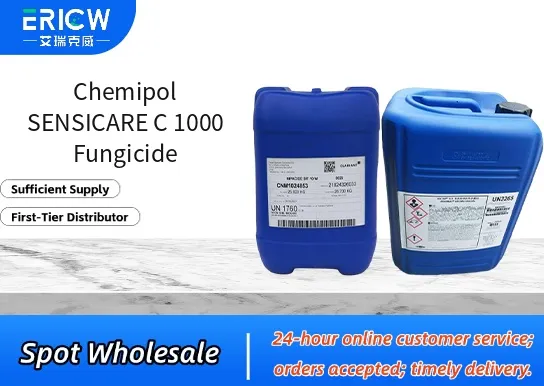
Q1: What types of polymers is Chemipol SENSICARE C 1000 compatible with?
A: Chemipol SENSICARE C 1000 is designed for use in thermoplastic polymers including polyolefins (e.g., PP and PE), engineering plastics such as ABS and PC, and certain elastomers. Compatibility should be verified through preliminary testing under actual processing conditions.
Q2: How is Chemipol SENSICARE C 1000 typically incorporated into polymer formulations?
A: It is commonly introduced via masterbatch dilution or direct dry-blend addition prior to extrusion or injection molding. Thermal stability allows for incorporation at standard polymer processing temperatures without significant degradation.
Q3: Does Chemipol SENSICARE C 1000 affect the mechanical or optical properties of the final polymer product?
A: When used within recommended dosage ranges, it generally has minimal impact on tensile strength, impact resistance, or clarity—particularly in transparent or semi-crystalline systems. However, performance may vary depending on base resin, additives, and processing history.
Q4: Is Chemipol SENSICARE C 1000 suitable for applications requiring long-term antimicrobial protection?
A: Yes—it provides durable, non-leaching fungicidal activity that remains effective throughout the intended service life of the polymer article, especially in indoor environments and under moderate humidity conditions.
Contact With Us:
E-mail: wangxingqiang@ericwchem.com
Have a Questions? Call Us:
Add:
Building A1, Jiete Industrial Park, Huangpu District, Guangzhou City, Guangdong Province, China