English
 Español
 tiếng việt
 русский
Broad-spectrum fungicidal activity against key ascomycete and basidiomycete pathogens.
Non-systemic contact mode of action with rapid knockdown and protective residual performance.
Low volatility and minimal leaching, supporting environmental persistence in treated substrates.
Compatible with common industrial biocides and formulation additives for co-formulation flexibility.
Stable across pH 4–9 and tolerant to moderate thermal stress during processing and storage.
Preservation of water-based paints and coatings during storage and in-can protection.
Anti-fungal treatment for adhesives, caulks, and sealants exposed to humid environments.
Protection of paper and cardboard packaging against mold colonization during warehousing.
Stabilization of latex emulsions and polymer dispersions in architectural and industrial applications.
| Chemical Type | Organic heterocyclic fungicide (active ingredient: 2-methyl-1,2-benzisothiazol-3(2H)-one derivative) |
| Product Form | Liquid concentrate (aqueous dispersion) |
| Appearance | Opaque off-white to light beige suspension |
| pH (1% aqueous dilution) | 6.8–7.4 |
| Density (20°C) | 1.02–1.05 g/cm³ |
| Viscosity (25°C) | 25–45 mPa·s (Brookfield LVT, spindle #3, 6 rpm) |
| Shelf Life (unopened, 5–30°C) | 24 months |
| Solubility in Water | Partially miscible; forms stable dispersion with recommended dispersants |
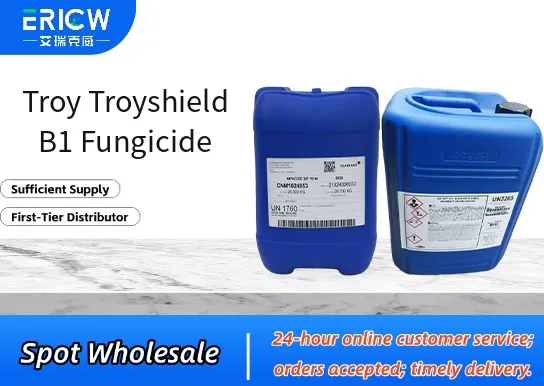
Q1: What types of formulations is Troy Troyshield B1 Fungicide typically used in?
A: Troy Troyshield B1 is commonly incorporated into water-based industrial coatings, adhesives, sealants, and construction chemicals where long-term protection against mold, mildew, and fungal degradation is required.
Q2: How does Troyshield B1 differ from broad-spectrum biocides intended for microbial control in liquid systems?
A: Unlike preservatives designed for in-can stabilization, Troyshield B1 is optimized for dry-film efficacy—providing persistent antifungal activity after the formulation has cured or dried on the substrate.
Q3: Is Troy Troyshield B1 compatible with common paint additives such as dispersants, defoamers, and thickeners?
A: Yes, Troyshield B1 demonstrates good compatibility with most conventional waterborne coating additives when added at recommended use levels; however, compatibility testing in the final formulation is always advised to confirm stability and performance.
Q4: What is the typical dosage range for effective antifungal performance in finished products?
A: Effective dosage generally ranges from 0.1% to 2% by weight in the final formulation, depending on the substrate, environmental exposure conditions, and desired longevity of protection.
Contact With Us:
E-mail: wangxingqiang@ericwchem.com
Have a Questions? Call Us:
Add:
Building A1, Jiete Industrial Park, Huangpu District, Guangzhou City, Guangdong Province, China