English
 Español
 tiếng việt
 русский
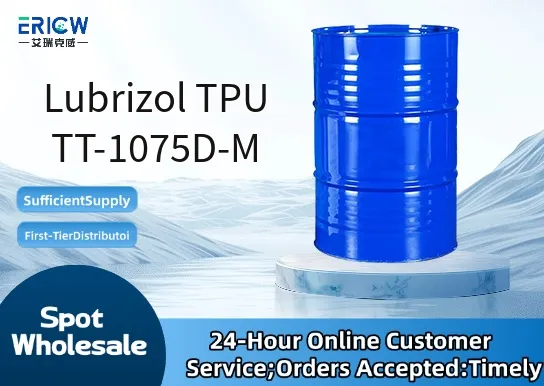
Excellent melt processability for high-output extrusion and injection molding.
Outstanding abrasion resistance and mechanical toughness at ambient and low temperatures.
Good hydrolytic stability, suitable for humid environments and extended service life.
Low-temperature flexibility with retained elasticity down to –30 °C.
Compatible with common TPU processing equipment and recyclable within closed-loop systems.
Automotive interior trim components including instrument panel skins and door panels.
Industrial hoses and pneumatic tubing requiring flex fatigue resistance.
Consumer electronics protective casings and flexible connectors.
Medical device housings and non-implantable wearable components.
High-performance sporting goods such as ski boots and protective gear linings.
| Chemical Type | Thermoplastic Polyurethane (TPU), Polyester-based |
| Product Form | Pellets |
| Appearance | Off-white, free-flowing granules |
| Hardness (Shore A) | 75 ± 2 |
| Melt Flow Index (230 °C / 2.16 kg) | 15–20 g/10 min |
| Density | 1.18–1.20 g/cm³ |
| Primary Applications | Extruded profiles, injection-molded parts, thermoformed components |
| Key Features | Process efficiency, dimensional stability, surface gloss retention |
Q1: What is the primary function of Lubrizol TPU TT-1075D-M in thermoplastic polyurethane (TPU) formulations?
A: Lubrizol TPU TT-1075D-M is a specialized processing aid and surface modifier designed to enhance melt flow, reduce extrusion torque, and improve surface gloss and slip characteristics in TPU compounds—particularly in demanding applications such as thin-gauge films, extruded profiles, and injection-molded parts.
Q2: Is TT-1075D-M compatible with all major TPU chemistries (e.g., polyester-, polyether-, and polycaprolactone-based TPUs)?
A: Yes, TT-1075D-M demonstrates broad compatibility across common TPU base resins, including aromatic and aliphatic variants. Compatibility testing under actual processing conditions is recommended to optimize dispersion and performance for specific polymer grades and end-use requirements.
Q3: How is TT-1075D-M typically incorporated into TPU processing?
A: It is commonly added during compounding via high-shear mixing or masterbatch dilution. Pre-dispersion in a portion of the TPU resin prior to full melt blending helps ensure uniform distribution. It is not intended for post-addition or direct dosing into molten polymer streams without prior stabilization.
Q4: Does TT-1075D-M affect the mechanical properties or thermal stability of finished TPU products?
A: When used within recommended dosage ranges, TT-1075D-M does not significantly compromise tensile strength, elongation, or heat resistance. In fact, improved melt homogeneity may contribute to more consistent mechanical performance across production batches.
Contact With Us:
E-mail: wangxingqiang@ericwchem.com
Have a Questions? Call Us:
Add:
Building A1, Jiete Industrial Park, Huangpu District, Guangzhou City, Guangdong Province, China