English
 Español
 tiếng việt
 русский
Excellent abrasion resistance for extended service life in demanding mechanical environments.
Broad processing window suitable for extrusion, injection molding, and blow molding.
Good low-temperature flexibility down to –30 °C without significant loss of elasticity.
Hydrolysis-resistant aliphatic polyester-based formulation ensuring long-term stability in humid conditions.
High transparency and gloss retention ideal for premium aesthetic applications.
Automotive interior trim components including instrument panel overlays and soft-touch surfaces.
Consumer electronics protective casings and flexible cable jacketing.
Medical tubing and non-implantable wearable device housings compliant with ISO 10993-5 cytotoxicity screening.
Industrial hose covers and pneumatic seal rings requiring dynamic flex endurance.
Sports equipment grips, gaskets, and vibration-damping pads.
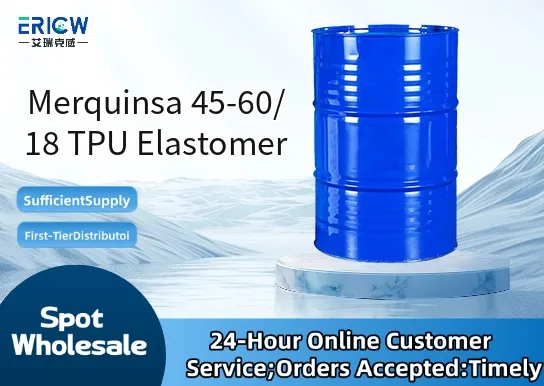
| Chemical Type | Aliphatic polyester-based thermoplastic polyurethane (TPU) |
| Product Form | Pellets (free-flowing, dry-blend ready) |
| Appearance | Translucent to semi-crystalline granules, uniform size distribution |
| Hardness (Shore A) | 45–60 |
| Melt Flow Index (2.16 kg, 210 °C) | 18 g/10 min |
| Density | 1.18–1.22 g/cm³ |
| Key Features | Abrasion resistance, hydrolytic stability, process versatility, optical clarity |
| Primary Applications | Extruded profiles, molded parts, overmolding substrates, flexible tubing |
Q1: What is the primary chemical composition and structural class of Merquinsa 45-60/18?
A: Merquinsa 45-60/18 is a thermoplastic polyurethane (TPU) elastomer based on polyester chemistry, featuring a segmented structure with alternating hard segments (typically aromatic diisocyanate and chain extender-derived domains) and soft segments (polyester polyol-derived). Its designation reflects its Shore A hardness range and processing characteristics.
Q2: Is this TPU suitable for extrusion and injection molding applications?
A: Yes — Merquinsa 45-60/18 is specifically engineered for high-melt-stability processing. It performs well in both melt extrusion (e.g., for films, profiles, or monofilaments) and injection molding of flexible components, offering good melt strength, low die swell, and consistent flow behavior across standard processing windows.
Q3: How does this grade compare to polyether-based TPUs in terms of hydrolytic stability and low-temperature flexibility?
A: As a polyester-type TPU, Merquinsa 45-60/18 offers superior mechanical strength, abrasion resistance, and oil/fuel resistance compared to polyether analogues. However, it has lower inherent hydrolytic stability under prolonged hot/humid conditions and slightly reduced low-temperature flexibility — stabilization additives and controlled processing environments are recommended for demanding humid or sub-zero service conditions.
Q4: Can Merquinsa 45-60/18 be blended or compounded with other polymers?
A: Yes — it demonstrates good compatibility with certain engineering thermoplastics (e.g., PC, ABS) and other polyester-based materials when used as a modifier or impact enhancer. Compatibility with non-polar polymers like PP or PE is limited without compatibilizers. Blending trials should always include rheological and phase morphology evaluation to ensure performance integrity.
Contact With Us:
E-mail: wangxingqiang@ericwchem.com
Have a Questions? Call Us:
Add:
Building A1, Jiete Industrial Park, Huangpu District, Guangzhou City, Guangdong Province, China