English
 Español
 tiếng việt
 русский
Excellent abrasion resistance for extended service life in demanding mechanical environments.
High tensile strength and elongation at break, enabling robust performance under dynamic stress.
Good low-temperature flexibility down to –30 °C, maintaining elasticity in cold-condition applications.
Outstanding oil and grease resistance, suitable for industrial fluid-contact scenarios.
Processable via standard thermoplastic techniques including injection molding, extrusion, and blow molding.
Automotive interior trim components requiring soft-touch feel and durability.
Industrial hoses and pneumatic tubing exposed to oils and repeated flexing.
Mobile device protective casings with impact absorption and surface scratch resistance.
Conveyor belts and wear strips in material handling systems.
Footwear midsoles and outsoles demanding rebound resilience and weather stability.
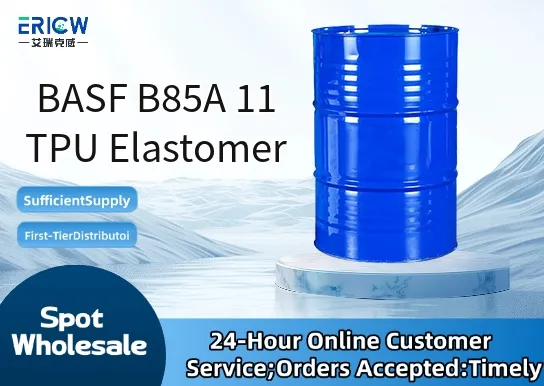
| Chemical Type | Thermoplastic Polyurethane (TPU), polyester-based |
| Product Form | Pellets |
| Appearance | Off-white to light beige, free-flowing granules |
| Density (ISO 1183) | 1.20 g/cm³ |
| Melt Flow Index (ISO 1133, 230 °C/2.16 kg) | 12 g/10 min |
| Shore A Hardness (ISO 868) | 85 ± 2 |
| Tensile Strength (ISO 527-2) | 42 MPa |
| Elongation at Break (ISO 527-2) | 550 % |
Q1: What are the key processing advantages of BASF B85A 11 compared to conventional TPU grades?
A: BASF B85A 11 is specifically engineered for enhanced melt stability and lower viscosity at processing temperatures, enabling smoother extrusion and injection molding—particularly beneficial for thin-walled or highly detailed parts. Its optimized thermal profile also supports faster cycle times and reduced risk of thermal degradation during repeated processing.
Q2: Is B85A 11 suitable for applications requiring resistance to hydrolysis and long-term flexibility retention?
A: Yes—B85A 11 is an aliphatic polyester-based TPU elastomer with inherently high resistance to hydrolytic cleavage, making it well-suited for humid environments or applications exposed to warm moisture over extended periods. Its molecular architecture helps maintain elasticity and mechanical integrity under such conditions.
Q3: Can B85A 11 be used in direct contact with food or potable water applications?
A: While B85A 11 is not pre-certified for food contact, it is formulated without plasticizers, heavy metals, or known endocrine disruptors. Regulatory compliance must be confirmed on a case-by-case basis through finished-product testing and evaluation against applicable regional requirements (e.g., FDA 21 CFR, EU Framework Regulation).
Q4: How does B85A 11 perform in low-temperature flexibility applications?
A: Due to its low glass transition temperature and flexible soft-segment structure, B85A 11 retains excellent elasticity and impact resistance down to sub-zero temperatures, supporting reliable performance in cold-climate automotive, outdoor equipment, and flexible tubing applications.
Contact With Us:
E-mail: wangxingqiang@ericwchem.com
Have a Questions? Call Us:
Add:
Building A1, Jiete Industrial Park, Huangpu District, Guangzhou City, Guangdong Province, China