English
 Español
 tiếng việt
 русский
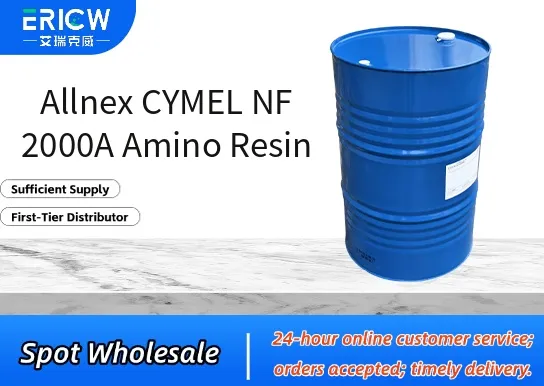
Highly reactive melamine-formaldehyde resin offering rapid cure at low baking temperatures.
Excellent compatibility with acrylic, polyester, and alkyd resins in thermosetting coating systems.
Provides outstanding hardness, gloss retention, and chemical resistance in finished films.
Low formaldehyde emission profile, supporting compliance with stringent environmental and safety regulations.
Good storage stability in solvent-based formulations without premature self-condensation.
Automotive OEM and refinish topcoats requiring high-gloss, durable finishes.
Industrial coil coatings for metal roofing, cladding, and appliance panels.
General-purpose can coatings for food and beverage containers.
Powder coating clearcoats and hybrid powder systems demanding fast throughput.
| Chemical Type | Melamine-formaldehyde resin |
| Product Form | Liquid |
| Appearance | Clear to slightly hazy, colorless to pale yellow liquid |
| Solvent | Isobutanol / n-Butanol blend |
| Non-Volatile Content (wt%) | 75–78% |
| Viscosity (25°C, mPa·s) | 1,200–2,000 |
| Acid Number (mg KOH/g) | < 5 |
| Primary Applications | Thermosetting industrial coatings, automotive finishes, coil coatings |
Q1: What is the primary function of CYMEL NF 2000A in coating formulations?
A: CYMEL NF 2000A functions as a low-bake, highly reactive amino crosslinker, designed to enhance hardness, chemical resistance, and thermal stability in thermosetting coatings—particularly where fast cure at moderate temperatures is required.
Q2: Which resin types is CYMEL NF 2000A typically compatible with?
A: It exhibits excellent compatibility with hydroxyl-functional acrylics, polyesters, and alkyds. Its formulation is optimized for use in solventborne and high-solids systems, and it can be adapted for select water-reducible applications with appropriate co-solvent and catalyst selection.
Q3: How should CYMEL NF 2000A be stored to maintain optimal reactivity and shelf life?
A: Store in tightly sealed original containers in a cool, dry, and well-ventilated area, away from strong acids, bases, and moisture. Prolonged exposure to elevated temperatures or humidity may accelerate self-condensation and reduce crosslinking efficiency over time.
Q4: Is a catalyst required when using CYMEL NF 2000A, and if so, what types are recommended?
A: While CYMEL NF 2000A can cure without added catalyst under extended bake conditions, acid catalysts—such as blocked p-toluenesulfonic acid (PTSA) or weak organic acids—are commonly used to achieve full cure at lower temperatures (e.g., 120–160 °C) and shorter dwell times. Catalyst selection and dosage depend on the base resin system and desired cure profile.
Q5: Can CYMEL NF 2000A be used in food-contact coatings?
A: CYMEL NF 2000A is not pre-approved for direct food-contact applications. Formulators must conduct full regulatory evaluation—including migration testing and compliance verification—against applicable regional regulations before considering use in food packaging or processing equipment coatings.
Contact With Us:
E-mail: wangxingqiang@ericwchem.com
Have a Questions? Call Us:
Add:
Building A1, Jiete Industrial Park, Huangpu District, Guangzhou City, Guangdong Province, China