English
 Español
 tiếng việt
 русский
High reactivity with hydroxyl-functional resins for fast-cure, high-gloss coatings.
Excellent compatibility with acrylic, polyester, and alkyd binder systems.
Low formaldehyde emission profile meeting stringent environmental and regulatory requirements.
Superior storage stability in solvent-based formulations without premature gelation.
Enables excellent hardness development and chemical resistance in thermoset coatings.
Automotive OEM clearcoats and topcoats.
Industrial coil coatings for pre-painted metal substrates.
Appliance finishes requiring durability and mar resistance.
General-purpose can coatings for food and beverage containers.
Wood furniture and cabinetry coatings demanding high gloss and clarity.
| Chemical Type | Methoxymethylated melamine-formaldehyde resin |
| Product Form | Liquid |
| Appearance | Clear, pale yellow to colorless liquid |
| Solvent Content | ~70% (in n-butanol / xylene blend) |
| Non-Volatile Content | 60 ± 1 wt% |
| Viscosity (25°C) | 80–120 mPa·s (Brookfield RV) |
| Acid Number | < 1 mg KOH/g |
| Key Features | Low formaldehyde release, high crosslink density, excellent flow and leveling |
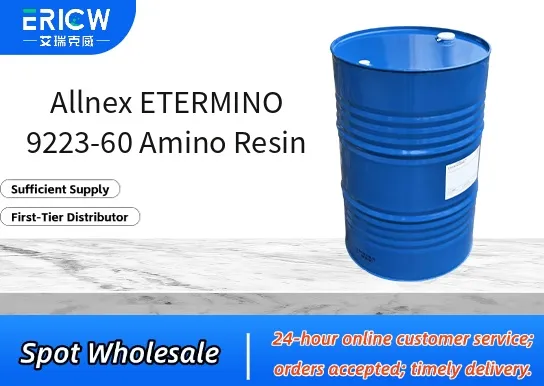
Q1: What is the primary function of ETERMINO 9223-60 in coating formulations?
A: ETERMINO 9223-60 is a low-viscosity, highly reactive amino resin designed to act as a crosslinker for hydroxyl-functional resins—such as acrylics, polyesters, and alkyds—in thermosetting coatings. It enhances cure speed, hardness, chemical resistance, and gloss retention under conventional or forced-dry conditions.
Q2: Is ETERMINO 9223-60 compatible with acid-catalyzed baking systems?
A: Yes, it is formulated for use with common organic acid catalysts (e.g., p-toluenesulfonic acid or blocked sulfonic acids) and performs well in standard acid-catalyzed oven-cure applications. Catalyst selection and dosage should be optimized based on cure schedule and substrate requirements.
Q3: How does ETERMINO 9223-60 compare to traditional melamine-formaldehyde resins in terms of formaldehyde release?
A: As a highly alkylated melamine resin, ETERMINO 9223-60 exhibits inherently low free formaldehyde content and reduced formaldehyde emission during cure compared to partially alkylated or unmodified melamine types—supporting improved workplace safety and compliance with volatile organic compound (VOC) and emissions guidelines.
Q4: Can ETERMINO 9223-60 be used in low-bake or UV-assisted thermal cure systems?
A: While primarily intended for conventional thermal curing (typically 120–160 °C), it has demonstrated compatibility in hybrid low-bake and UV-thermal processes when paired with appropriate photoinitiators and co-resins—though formulation optimization and cure profiling are recommended to ensure full crosslink development.
Contact With Us:
E-mail: wangxingqiang@ericwchem.com
Have a Questions? Call Us:
Add:
Building A1, Jiete Industrial Park, Huangpu District, Guangzhou City, Guangdong Province, China