English
 Español
 tiếng việt
 русский
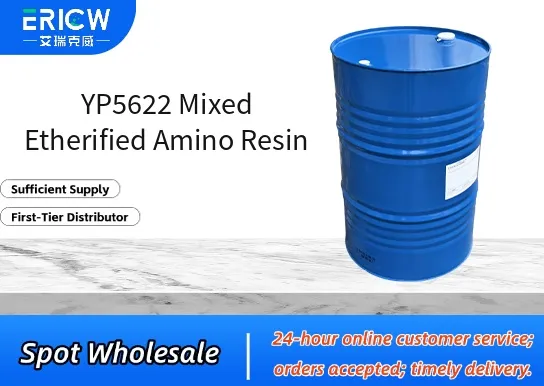
Excellent compatibility with melamine-formaldehyde and urea-formaldehyde resins for hybrid curing systems.
Low formaldehyde emission profile, supporting compliance with stringent VOC and indoor air quality standards.
Enhanced storage stability at ambient temperature without premature gelation or viscosity drift.
Fast-curing capability under conventional baking conditions (130–150 °C), enabling high-throughput coating processes.
Balanced reactivity and flexibility, delivering superior hardness, gloss retention, and chemical resistance in finished films.
Automotive OEM and refinish topcoats requiring high-gloss, chip-resistant finishes.
Industrial coil coatings for pre-painted metal used in building panels and appliances.
Can coatings for food and beverage containers demanding FDA-compliant cure performance.
Wood furniture and flooring finishes where rapid crosslinking and low-odor properties are critical.
General-purpose thermosetting powder coatings for metal substrates.
| Chemical Type | Mixed etherified melamine-formaldehyde resin |
| Product Form | Liquid |
| Appearance | Clear, pale yellow to colorless viscous liquid |
| Solvent Content | Butanol / Isopropanol blend (non-water-based) |
| Non-Volatile Content (NV%) | 78–82% (by weight, 105 °C, 60 min) |
| Viscosity (25 °C) | 800–1,200 mPa·s (Brookfield DV-II+ viscometer, spindle #3, 20 rpm) |
| Acid Number | ≤ 5 mg KOH/g |
| Storage Stability | ≥ 6 months at 25 °C in sealed container |
Q1: What is the primary function of YP5622 in coating and ink formulations?
A: YP5622 acts as a crosslinking agent that reacts with hydroxyl- or carboxyl-functional resins (e.g., acrylics, polyesters, or alkyds) under thermal curing conditions, enhancing hardness, chemical resistance, and film integrity.
Q2: Is YP5622 compatible with waterborne systems?
A: Yes — YP5622 is designed for compatibility with both solvent-borne and waterborne coatings. Its mixed etherification improves hydrolytic stability and colloidal dispersion in aqueous media, though formulation pH and co-solvent selection should be optimized during development.
Q3: How does YP5622 compare to fully methylated amino resins in terms of reactivity and storage stability?
A: The mixed etherification (e.g., methyl and butyl groups) balances reactivity and latency: it offers faster cure than highly butylated resins while maintaining better shelf life and pot life than fully methylated types, especially in acidic catalyzed systems.
Q4: What catalysts are typically recommended for use with YP5622?
A: Commonly used acid catalysts include p-toluenesulfonic acid (p-TSA), dodecylbenzenesulfonic acid (DBSA), or blocked acid systems. Catalyst selection depends on cure schedule, substrate sensitivity, and desired flow/leveling behavior — strong acids accelerate reaction but may reduce pot life.
Q5: Can YP5622 be used in low-bake or ambient-cure applications?
A: While YP5622 is primarily formulated for thermal cure (typically 120–160 °C), modified versions with enhanced reactivity or co-reactive additives may enable reduced-bake performance. Ambient cure is not typical without additional reactive components or catalyst activation.
Contact With Us:
E-mail: wangxingqiang@ericwchem.com
Have a Questions? Call Us:
Add:
Building A1, Jiete Industrial Park, Huangpu District, Guangzhou City, Guangdong Province, China