English
 Español
 tiếng việt
 русский
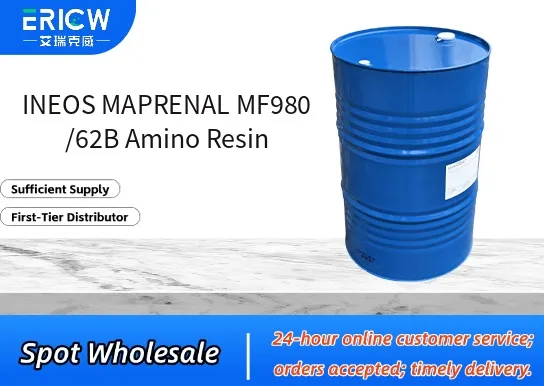
High reactivity with melamine-formaldehyde and urea-formaldehyde resins for rapid cure kinetics.
Excellent compatibility with alkyd, polyester, and acrylic binder systems in thermosetting coatings.
Superior storage stability in solvent-based formulations at ambient temperature.
Low formaldehyde emission profile, supporting compliance with stringent VOC and emissions regulations.
Consistent batch-to-batch performance ensured by INEOS’s controlled manufacturing process.
Automotive OEM and refinish topcoats requiring high-gloss, chip-resistant finishes.
Industrial coil coatings for pre-painted metal substrates in construction and appliance sectors.
Can and container coatings demanding excellent adhesion, corrosion resistance, and sterilization stability.
Wood furniture and panel coatings where rapid oven cure and low yellowing are critical.
General-purpose baking enamels for metal packaging and household appliances.
| Chemical Type | Melamine-formaldehyde crosslinker (alkylated) |
| Product Form | Liquid |
| Appearance | Clear, pale yellow to amber viscous liquid |
| Primary Applications | Thermosetting industrial coatings, automotive and appliance finishes |
| Key Features | High functionality, low viscosity, excellent flow and leveling |
| Benefits | Reduced curing time, improved film hardness, enhanced chemical resistance |
| Storage Stability | ≥12 months at 20–25 °C in sealed original container |
| Solubility | Compatible with common organic solvents (e.g., xylene, butanol, esters) |
Q1: What is the primary function of INEOS MAPRENAL MF980/62B in coating formulations?
A: INEOS MAPRENAL MF980/62B is a melamine-formaldehyde amino resin designed to act as a crosslinking agent for hydroxyl-functional resins—such as alkyds, acrylics, and polyesters—in thermosetting coatings. It enhances hardness, chemical resistance, and thermal stability upon cure.
Q2: Is MF980/62B suitable for low-bake or ambient-cure systems?
A: MF980/62B is formulated for conventional thermal curing, typically requiring bake temperatures in the range of 120–160 °C. While it can be catalyzed for reduced cure temperatures, it is not optimized for true ambient-cure applications without significant formulation adjustments and catalyst support.
Q3: How does MF980/62B differ from standard high-alkylated melamine resins?
A: MF980/62B features a balanced alkyl chain length and functionality profile, offering improved compatibility with mid-polarity binder systems and enhanced flow characteristics compared to highly alkylated variants—without sacrificing reactivity or final film performance.
Q4: What solvents are recommended for diluting MF980/62B prior to incorporation?
A: The resin is commonly diluted with aromatic hydrocarbons (e.g., xylene, Solvesso™ types) or ketones (e.g., methyl isobutyl ketone), depending on the target formulation polarity and VOC requirements. Alcohols should be avoided unless compatibility has been verified, due to potential transesterification risk.
Q5: Can MF980/62B be used in food-contact coating applications?
A: MF980/62B is not pre-approved for direct food-contact applications. Its suitability depends on full regulatory evaluation within the final cured coating system—including migration testing, catalyst selection, and processing conditions—as required by applicable regional food-contact regulations.
Contact With Us:
E-mail: wangxingqiang@ericwchem.com
Have a Questions? Call Us:
Add:
Building A1, Jiete Industrial Park, Huangpu District, Guangzhou City, Guangdong Province, China