English
 Español
 tiếng việt
 русский
High reactivity with hydroxyl-functional resins, enabling efficient crosslinking at moderate cure temperatures.
Excellent compatibility with acrylic, polyester, and alkyd resins for broad-formulation flexibility.
Low formaldehyde emission profile, supporting compliance with stringent VOC and emissions regulations.
Good storage stability in solvent-based systems when properly inhibited and handled.
Enables high-gloss, durable finishes with superior hardness and chemical resistance.
Automotive OEM clearcoats and basecoats.
Industrial coil coatings for metal roofing and appliances.
General-purpose can and container coatings.
Wood furniture and cabinetry finishes.
Electrical insulation varnishes and impregnating resins.
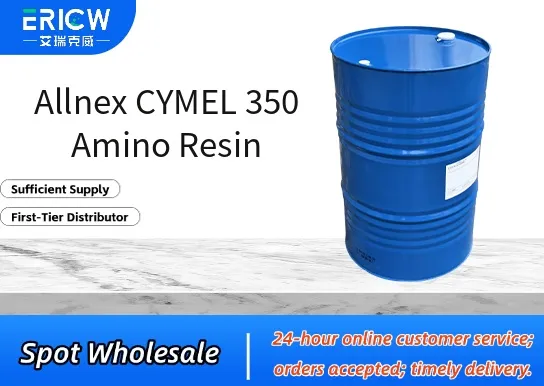
| Chemical Type | Methylated melamine-formaldehyde resin |
| Product Form | Liquid |
| Appearance | Clear to slightly hazy, pale yellow liquid |
| Non-Volatile Content (105°C, 60 min) | 80–84 wt% |
| Viscosity (25°C, Brookfield RV, spindle #3, 20 rpm) | 150–350 mPa·s |
| Density (25°C) | 1.20–1.24 g/cm³ |
| Solvent | n-Butanol |
| Primary Applications | Thermosetting coatings requiring fast cure and high performance |
Q1: What is the primary function of CYMEL 350 in coating formulations?
A: CYMEL 350 acts as a highly reactive melamine-formaldehyde crosslinker, enabling thermoset formation at relatively low curing temperatures. It enhances hardness, chemical resistance, and durability when combined with hydroxyl- or carbamate-functional resins such as acrylics, alkyds, or polyesters.
Q2: Is CYMEL 350 compatible with acid-catalyzed systems?
A: Yes — CYMEL 350 is commonly used with strong or weak organic acid catalysts (e.g., p-toluenesulfonic acid or blocked acids) to accelerate cure kinetics. Catalyst selection and dosage should be optimized based on desired pot life, flow, and final film properties.
Q3: How does CYMEL 350 compare to other CYMEL resins in terms of reactivity and volatility?
A: CYMEL 350 offers moderate reactivity and lower formaldehyde volatility compared to highly methylolated grades like CYMEL 303, making it suitable for applications where balanced cure speed and reduced emissions are priorities. Its butanol content provides good solubility and handling characteristics in conventional solvent-borne systems.
Q4: Can CYMEL 350 be used in water-reducible or high-solids coatings?
A: While traditionally formulated in solvent-borne systems, CYMEL 350 can be incorporated into water-reducible or high-solids coatings with appropriate resin selection and formulation adjustments. Compatibility testing is recommended to ensure stability, dispersion, and cure performance under specific application conditions.
Q5: What are typical storage and handling considerations for CYMEL 350?
A: Store in tightly sealed containers in a cool, dry, well-ventilated area away from strong oxidizers and direct sunlight. Avoid prolonged exposure to moisture or elevated temperatures, which may affect shelf life and reactivity. Always follow Allnex’s Safety Data Sheet (SDS) for safe handling, personal protection, and disposal guidance.
Contact With Us:
E-mail: wangxingqiang@ericwchem.com
Have a Questions? Call Us:
Add:
Building A1, Jiete Industrial Park, Huangpu District, Guangzhou City, Guangdong Province, China