English
 Español
 tiếng việt
 русский
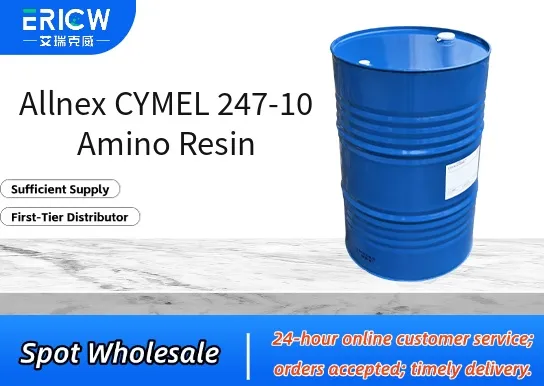
Highly reactive melamine-formaldehyde resin offering excellent cure speed at low baking temperatures.
Superior compatibility with acrylic, polyester, and alkyd resins in solventborne coating systems.
Delivers outstanding hardness, gloss retention, and chemical resistance in thermoset coatings.
Low formaldehyde content formulation supporting improved workplace safety and regulatory compliance.
Excellent flow and leveling characteristics for high-appearance industrial finishes.
Automotive OEM and refinish topcoats.
Industrial coil and can coatings.
Appliance and metal furniture coatings.
General-purpose industrial maintenance coatings.
High-performance powder coating hybrids (when blended with appropriate polyols).
| Chemical Type | Melamine-formaldehyde crosslinker |
| Product Form | Liquid |
| Appearance | Clear to slightly hazy, water-white liquid |
| Solvent | Isobutanol |
| Solids Content | 80 ± 1 wt% |
| Viscosity (25°C) | 80–120 mPa·s (cP) |
| Density (25°C) | 0.92–0.94 g/cm³ |
| pH (10% solution in water) | 7.5–8.5 |
Q1: What is the primary function of CYMEL 247-10 in coating formulations?
A: CYMEL 247-10 is a highly reactive melamine-formaldehyde crosslinker designed to enhance hardness, chemical resistance, and thermal stability in thermosetting coatings—particularly in high-performance industrial and coil coating systems based on polyester, acrylic, or alkyd resins.
Q2: How does CYMEL 247-10 differ from other CYMEL® resins like CYMEL 303 or CYMEL 323?
A: CYMEL 247-10 features a tailored degree of methylation and lower free formaldehyde content compared to conventional hexamethoxymethylmelamine (HMMM) types, offering improved storage stability and reduced volatility while maintaining good reactivity under typical baking conditions (typically 140–180 °C).
Q3: Is CYMEL 247-10 suitable for low-bake or ambient-cure applications?
A: CYMEL 247-10 is optimized for thermal cure processes and generally requires elevated temperatures (≥130 °C) to achieve full crosslinking. It is not recommended for true ambient-cure systems; however, it may be used in low-bake formulations when paired with appropriate acid catalysts and resin partners that lower the effective cure window.
Q4: What are common compatibility considerations when formulating with CYMEL 247-10?
A: CYMEL 247-10 exhibits good compatibility with hydroxyl-functional polyester, acrylic, and alkyd resins. For optimal performance, formulations should maintain appropriate acid number balance and avoid strongly basic additives that may hinder catalysis. Compatibility testing is recommended when blending with silicone-modified or fluorinated resins.
Contact With Us:
E-mail: wangxingqiang@ericwchem.com
Have a Questions? Call Us:
Add:
Building A1, Jiete Industrial Park, Huangpu District, Guangzhou City, Guangdong Province, China