English
 Español
 tiếng việt
 русский
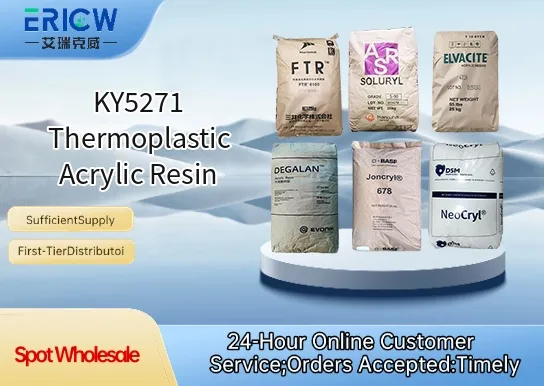
Excellent clarity and high-gloss finish for premium optical performance.
Outstanding UV resistance and long-term color stability under outdoor exposure.
Good melt flow characteristics enabling efficient extrusion and injection molding.
High impact strength combined with inherent toughness at ambient and low temperatures.
Solvent-soluble in common organic solvents (e.g., methyl ethyl ketone, toluene) for coating and adhesive formulations.
Automotive exterior trim and decorative emblems.
Transparent lenses and light covers for LED lighting systems.
High-clarity signage and point-of-purchase displays.
Thermoplastic coatings for metal and plastic substrates.
Binders in specialty printing inks and overprint varnishes.
| Chemical Type | Thermoplastic acrylic copolymer |
| Product Form | Pellets or free-flowing granules |
| Appearance | White to off-white translucent pellets |
| Glass Transition Temperature (Tg) | 102–108 °C (DSC, 10 °C/min) |
| Melt Flow Index (MFI) | 4.5–6.5 g/10 min (230 °C / 3.8 kg) |
| Specific Gravity | 1.18–1.20 (at 23 °C) |
| Moisture Content | ≤ 0.2 wt% (as received) |
| Primary Applications | Exterior automotive parts, optical components, coatings, and specialty inks |
Q1: What are the primary processing advantages of KY5271 compared to other thermoplastic acrylic resins?
A: KY5271 offers excellent melt flow and low melt viscosity, enabling efficient extrusion and injection molding at moderate temperatures. Its narrow molecular weight distribution contributes to consistent film formation and reduced thermal degradation during high-speed processing.
Q2: Is KY5271 suitable for use in food-contact coatings or inks?
A: KY5271 is formulated without intentionally added heavy metals or plasticizers and is commonly selected for non-migrating overprint varnishes and protective topcoats where regulatory compliance is required. Final suitability depends on full formulation evaluation and adherence to applicable regional food-contact regulations.
Q3: How does KY5271 perform in UV-curable hybrid systems?
A: KY5271 exhibits good compatibility with acrylate monomers and oligomers, enhancing substrate adhesion and surface hardness in hybrid UV/thermal cure formulations. It remains stable under typical UV exposure conditions and does not significantly inhibit photoinitiator activity.
Q4: Can KY5271 be used as a rheology modifier in solvent-based systems?
A: Yes — KY5271 provides effective sag resistance and improved leveling in aromatic and aliphatic solvent-based coatings. Its performance as a thickener is concentration-dependent and typically used at low concentrations to avoid excessive viscosity build-up.
Contact With Us:
E-mail: wangxingqiang@ericwchem.com
Have a Questions? Call Us:
Add:
Building A1, Jiete Industrial Park, Huangpu District, Guangzhou City, Guangdong Province, China