English
 Español
 tiếng việt
 русский
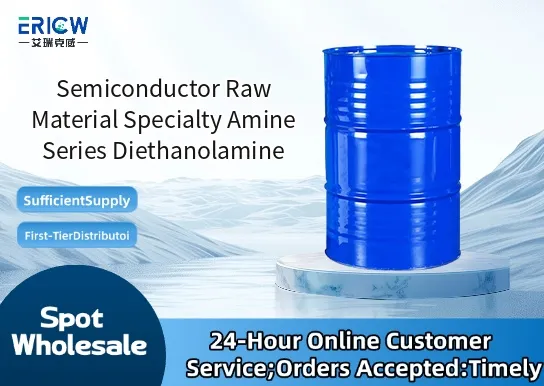
Ultra-high purity (≥99.95%) with stringent trace metal control (<10 ppb Fe, Cu, Ni, Na), essential for semiconductor-grade process compatibility.
Low volatility and thermal stability up to 180°C, enabling reliable performance in high-temperature CMP slurry formulation and post-etch cleaning processes.
Controlled amine basicity (pKb ≈ 4.8) for precise pH buffering in ultra-dilute chemistries without inducing unwanted metal hydroxide precipitation.
Non-volatile residue-free evaporation profile, minimizing particulate generation and surface contamination on 300 mm wafers.
Manufactured under ISO 9001 and ISO 14001 certified cleanroom conditions with full lot traceability and QC documentation per shipment.
Chemical Mechanical Planarization (CMP) slurry additive for copper and low-k dielectric polishing, enhancing selectivity and surface uniformity.
pH stabilizer and complexing agent in post-chemical etch rinse formulations for advanced logic and memory device fabrication.
Co-solvent and corrosion inhibitor in wafer-level cleaning solutions for EUV lithography mask handling and front-end-of-line (FEOL) processing.
Functional component in photoresist stripper co-formulations to suppress amine-induced pattern swelling and interlayer diffusion.
Stabilizer for nanoparticle dispersions in advanced packaging underfill and die-attach material development.
| Chemical Type | Secondary alkanolamine |
| Product Form | Clear, colorless to pale yellow liquid |
| Appearance | Homogeneous, free of suspended particles or phase separation |
| Melting Point | 28–30°C (solidifies below room temperature; supplied as stabilized liquid) |
| Primary Applications | Semiconductor wet processing: CMP slurries, etch rinses, cleaning formulations |
| Key Features | Ultra-low metallic impurities, low TOC (<5 ppm), high batch-to-batch consistency |
| Benefits | Reduces defect density, improves process window stability, extends slurry shelf life |
| Regulatory Compliance | REACH registered; RoHS compliant; no SVHCs listed in current candidate list |
| Common Compatible Systems | Suitability |
| Hydrogen Peroxide–Based Oxidative Slurries | Highly Recommended – Enhances copper oxide dissolution kinetics without accelerating H₂O₂ decomposition |
| Chelating Acid Rinse Solutions (e.g., citric/phosphoric blends) | Recommended – Improves metal ion sequestration and reduces re-deposition on Si surfaces |
| Nonionic Surfactant-Stabilized Dispersions | Suitable – Maintains colloidal stability without disrupting micelle integrity at ≤0.5 wt% loading |
| Fluorinated Polymer Etch Resists | Recommended – No observed swelling or adhesion loss in qualification testing (24h immersion, 25°C) |
Q1: What is the CAS Registry Number for this specialty diethanolamine grade?
A: The CAS number is 111-42-2. This refers specifically to diethanolamine (DEA); our semiconductor-grade product carries additional purity certification (Lot-Spec Sheet #SMA-DEA-SEM-2024) confirming compliance with SEMI C37 standards.
Q2: What is the typical recommended dosage range in CMP slurries?
A: For copper CMP applications, the effective dosage range is 0.05–0.3 wt% relative to total slurry mass. Optimization requires DOE validation due to interactions with abrasive type, oxidizer concentration, and pH.
Q3: How does this specialty DEA differ from commercial-grade diethanolamine?
A: Unlike technical-grade DEA, this variant undergoes multi-stage vacuum distillation, sub-micron filtration, and final IC-compatible packaging in nitrogen-purged HDPE carboys. Trace metals are reduced by >99.9% versus standard grades, and volatile organic impurities (e.g., morpholine, ethanolamine) are undetectable by GC-MS (LOD <1 ppm).
Q4: Is there data available on extractables/migration into deionized water under semiconductor rinse conditions?
A: Yes. Per SEMI F57-0319 testing, extractables in 18.2 MΩ·cm DI water at 25°C after 4h contact time are <0.2 ppb total organic carbon and <0.5 ppb sodium — well below ITRS-defined limits for 5nm node manufacturing.
Contact With Us:
E-mail: wangxingqiang@ericwchem.com
Have a Questions? Call Us:
Add:
Building A1, Jiete Industrial Park, Huangpu District, Guangzhou City, Guangdong Province, China