English
 Español
 tiếng việt
 русский
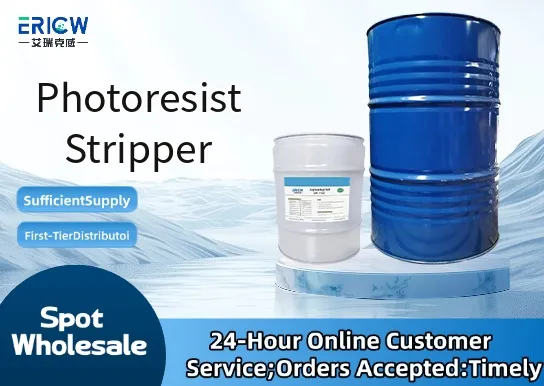
Fast-acting, residue-free removal of both positive and negative photoresists across multiple lithography platforms.
Non-corrosive formulation designed to preserve sensitive metal layers (e.g., Al, Cu, TiN) and low-k dielectrics.
Low surface tension and high wettability ensure uniform cleaning in high-aspect-ratio features and complex topographies.
Compatible with automated wet benches, spray systems, and ultrasonic immersion processes without foaming or carryover issues.
Stable at room temperature with extended shelf life (>24 months unopened); no refrigeration required.
Post-etch and post-ion implant resist stripping in semiconductor front-end-of-line (FEOL) manufacturing.
Removal of hardened resists after plasma etch or ashing in advanced logic and memory device fabrication.
Cleaning of photomasks and reticles during mask shop rework and qualification cycles.
Resist removal in MEMS, compound semiconductor (GaAs, SiC), and power device processing lines.
Wafer-level packaging (WLP) and fan-out processes requiring gentle, non-damaging organic residue clearance.
| Chemical Type | Organic solvent-based blend (non-halogenated, amine-free) |
| Product Form | Liquid, ready-to-use |
| Appearance | Clear, colorless to pale yellow liquid |
| Boiling Point Range | 158–172 °C |
| Density (20 °C) | 0.92–0.96 g/cm³ |
| pH (1% aqueous dilution) | Neutral (6.8–7.3) |
| Primary Applications | Photoresist stripping, post-etch residue removal, sidewall polymer clean |
| Regulatory Compliance | REACH compliant; RoHS 2015/863 Annex II compliant; no SVHCs above 0.1% w/w |
| Common Compatible Systems | Suitability |
| SEZ® (Screen) Wet Processing Systems | Highly Recommended – Optimized for spray rinse and static/dynamic immersion modes |
| Modutek® Teflon®-lined Batch Tanks | Recommended – Stable performance at 60–80 °C with minimal vapor pressure concerns |
| Ultrasonics (Kaijo, Crest) with DI water rinse | Suitable – Effective for small-batch R&D and prototype wafers; requires controlled dwell time |
| Single-wafer spin-rinse developers (e.g., Tokyo Electron CLEAN TRACK) | Highly Recommended – Validated for integration into track-based strip modules with <5 ppm metallic impurity tolerance |
Q1: What is the CAS Registry Number for this Photoresist Stripper?
A: This is a proprietary multi-component formulation; individual CAS numbers are not assigned to the final product. Full ingredient disclosure (including CAS numbers for all constituents >0.1% w/w) is provided in the Safety Data Sheet (SDS) Section 3.
Q2: What is the recommended process temperature and dwell time for optimal stripping performance?
A: Standard operation is at 65–75 °C for 90–180 seconds in immersion or 60–120 seconds in spray mode. For hardened resists, extend dwell time up to 300 seconds — validation with your specific resist stack is advised.
Q3: How does this stripper compare to NMP-based or sulfuric acid/peroxide (Piranha) alternatives?
A: Unlike NMP (a reproductive toxin, REACH SVHC), this formulation avoids hazardous solvents and eliminates safety risks associated with Piranha (explosive, highly corrosive). It delivers comparable strip rates with superior material compatibility and reduced EHS burden.
Q4: Are there any known extractables or leachables when used with fluoropolymer (e.g., PFA, FEP) fluid-handling components?
A: Extensive compatibility testing confirms no measurable extractables from PFA, FEP, or ETFE tubing/fittings under standard process conditions. Extractables screening per USP <87> and <88> shows <0.5 µg/cm² total organic leachables.
Contact With Us:
E-mail: wangxingqiang@ericwchem.com
Have a Questions? Call Us:
Add:
Building A1, Jiete Industrial Park, Huangpu District, Guangzhou City, Guangdong Province, China