English
 Español
 tiếng việt
 русский
Excellent abrasion resistance for extended service life in demanding mechanical environments.
Outstanding low-temperature flexibility down to –40 °C without significant loss of elasticity.
Good oil and grease resistance, maintaining dimensional stability in contact with hydrocarbon-based fluids.
High tensile strength and elongation at break, enabling reliable performance under dynamic stress.
Processable via standard thermoplastic techniques including injection molding, extrusion, and blow molding.
Industrial hoses and tubing for pneumatic and hydraulic systems.
Dynamic seals and gaskets in automotive and machinery components.
Wear-resistant conveyor belts and scraper blades.
Flexible couplings and vibration-damping elements.
Specialty footwear components requiring high resilience and flex fatigue resistance.
| Chemical Type | Thermoplastic Polyurethane (TPU), polyester-based |
| Product Form | Pellets |
| Appearance | Off-white to light beige, free-flowing granules |
| Primary Applications | Dynamic mechanical parts, flexible industrial components |
| Key Features | Abrasion resistance, low-temperature flexibility, oil resistance |
| Processing Method | Injection molding, extrusion, blow molding |
| Density (g/cm³) | 1.18–1.22 |
| Melt Flow Index (230 °C / 5 kg, g/10 min) | 15–25 |
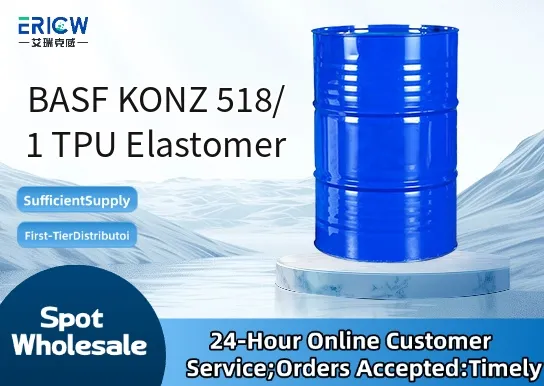
Q1: What is the primary function of BASF KONZ 518/1 in TPU formulations?
A: KONZ 518/1 is a specialized processing aid designed to improve melt flow and reduce extrusion torque in thermoplastic polyurethane (TPU) compounds, particularly during high-output compounding or profile extrusion.
Q2: Is KONZ 518/1 compatible with all major TPU chemistries (e.g., polyester-, polyether-, and polycaprolactone-based TPUs)?
A: Yes, KONZ 518/1 demonstrates broad compatibility across common TPU base resins. Performance may vary depending on molecular weight, hardness, and polarity—so formulation-specific evaluation is recommended before full-scale implementation.
Q3: How does KONZ 518/1 affect the mechanical properties of the final TPU product?
A: When used within the recommended dosage range, KONZ 518/1 typically has minimal impact on tensile strength, elongation, or hardness. It is formulated to support processability without compromising key performance attributes of the base TPU.
Q4: Can KONZ 518/1 be added directly during extrusion, or is pre-blending required?
A: KONZ 518/1 can be introduced either via gravimetric feeding alongside the TPU resin or as a masterbatch—both methods are widely used. Direct addition during twin-screw extrusion is common and effective when feed stability and dispersion are optimized.
Contact With Us:
E-mail: wangxingqiang@ericwchem.com
Have a Questions? Call Us:
Add:
Building A1, Jiete Industrial Park, Huangpu District, Guangzhou City, Guangdong Province, China