English
 Español
 tiếng việt
 русский
Excellent abrasion resistance for demanding mechanical environments.
High elasticity and recovery performance after repeated deformation.
Good low-temperature flexibility down to –30 °C.
Outstanding oil, grease, and hydrocarbon resistance.
Processable via extrusion, injection molding, and calendering.
Automotive interior trim components including instrument panel skins and door panels.
Industrial hoses and pneumatic tubing requiring flex fatigue resistance.
Protective coatings and overmolding for hand tools and power equipment grips.
Seals and gaskets in hydraulic systems exposed to mineral oils.
Roller covers and conveyor belt components in material handling systems.
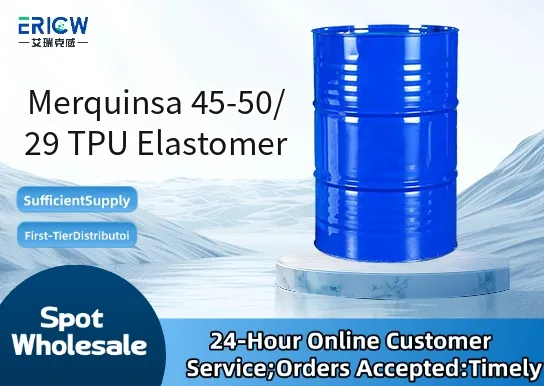
| Chemical Type | Thermoplastic Polyurethane (TPU), polyester-based |
| Product Form | Pellets |
| Appearance | Off-white to light tan, free-flowing granules |
| Shore A Hardness | 45–50 |
| Melt Flow Index (210 °C / 5 kg) | 29 g/10 min |
| Density | 1.18–1.22 g/cm³ |
| Primary Applications | Extruded profiles, molded parts, soft-touch overmolds |
| Key Features | Abrasion resistance, elasticity, oil resistance, processability |
Q1: What is the primary application domain for Merquinsa 45-50/29?
A: Merquinsa 45-50/29 is a thermoplastic polyurethane elastomer specifically engineered for demanding extrusion and injection molding applications, including flexible tubing, technical profiles, and soft-touch overmolding—particularly where resilience, abrasion resistance, and consistent melt processability are required.
Q2: How does Merquinsa 45-50/29 differ from standard aromatic TPU grades?
A: Unlike conventional aromatic TPUs, Merquinsa 45-50/29 features a tailored hard-segment architecture that balances thermal stability with improved hydrolytic resistance—making it more suitable for humid environments or extended outdoor exposure without rapid property degradation.
Q3: Is drying required before processing, and what are typical drying recommendations?
A: Yes—like most hygroscopic TPUs, Merquinsa 45-50/29 must be thoroughly dried prior to processing. Standard practice involves drying at 80–90 °C for 2–4 hours using a desiccant dryer; moisture content should be maintained below 0.05% to avoid surface defects and molecular weight reduction during melt processing.
Q4: Can this grade be used in direct food-contact or medical applications?
A: Merquinsa 45-50/29 is not pre-certified for food-contact or medical use. Its suitability for such applications depends on final formulation, processing conditions, and end-product regulatory validation—users must conduct full compliance testing per applicable regional requirements.
Contact With Us:
E-mail: wangxingqiang@ericwchem.com
Have a Questions? Call Us:
Add:
Building A1, Jiete Industrial Park, Huangpu District, Guangzhou City, Guangdong Province, China