English
 Español
 tiếng việt
 русский
Excellent melt processability for high-speed extrusion and injection molding.
Outstanding abrasion resistance and mechanical toughness at ambient and elevated temperatures.
Good hydrolytic stability, especially suitable for humid or wet-end applications.
Low-temperature flexibility down to –40 °C without significant loss of elasticity.
Compatible with common polyurethane processing equipment and standard drying protocols.
Automotive interior trim components including instrument panel skins and door panels.
Industrial hoses and pneumatic tubing requiring oil and ozone resistance.
High-performance footwear midsoles and outsoles demanding rebound and durability.
Medical-grade tubing and connectors where biocompatibility and sterilization compatibility are required.
Consumer electronics protective casings and flexible cable jackets.
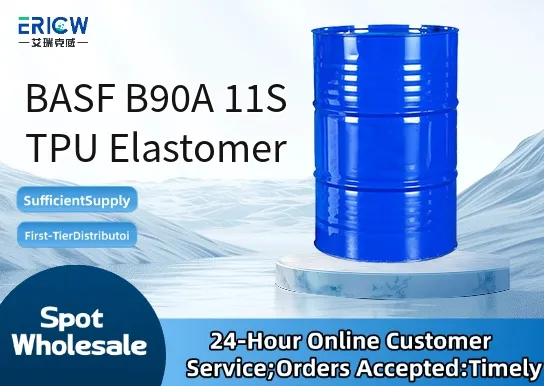
| Chemical Type | Thermoplastic Polyurethane (TPU), Polyester-based |
| Product Form | Pellets |
| Appearance | Off-white to light beige, free-flowing granules |
| Primary Applications | Extrusion, injection molding, calendering |
| Key Features | High tensile strength, excellent tear resistance, low compression set |
| Benefits | Reduced cycle times, improved surface finish, recyclable within closed-loop processes |
| Drying Recommendation | 80–100 °C for 2–4 hours prior to processing |
| Processing Temperature Range | 190–230 °C (melt temperature) |
Q1: What are the key processing advantages of BASF B90A 11S compared to conventional TPU grades?
A: BASF B90A 11S is specifically engineered for enhanced melt stability and reduced viscosity at processing temperatures, enabling smoother extrusion and injection molding—particularly beneficial for thin-walled or highly detailed parts. Its optimized flow behavior supports faster cycle times and improved surface finish without requiring major equipment modifications.
Q2: Is B90A 11S suitable for applications requiring high abrasion resistance and flexibility at low temperatures?
A: Yes—B90A 11S delivers a balanced combination of excellent abrasion resistance, high elasticity, and retained flexibility down to sub-zero temperatures. This makes it well-suited for dynamic components such as automotive interior trims, protective casings, and industrial rollers where mechanical resilience under variable thermal conditions is critical.
Q3: Can B90A 11S be co-extruded or overmolded with other thermoplastics?
A: B90A 11S demonstrates good adhesion to common engineering thermoplastics—including polypropylene, ABS, and certain PC/ABS blends—when processed under controlled temperature and surface preparation conditions. Successful co-processing typically requires optimization of interfacial temperature, residence time, and mold design to ensure robust bonding without delamination.
Q4: How does B90A 11S perform in terms of hydrolytic stability compared to polyester-based TPUs?
A: As a polyether-based TPU, B90A 11S offers significantly improved resistance to hydrolysis relative to standard polyester TPUs—especially under warm, humid conditions or prolonged exposure to moisture. This enhances long-term dimensional stability and mechanical retention in demanding environments such as outdoor consumer goods or medical device housings.
Contact With Us:
E-mail: wangxingqiang@ericwchem.com
Have a Questions? Call Us:
Add:
Building A1, Jiete Industrial Park, Huangpu District, Guangzhou City, Guangdong Province, China