English
 Español
 tiếng việt
 русский
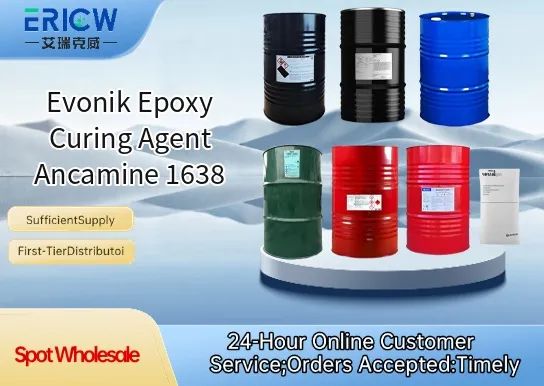
Fast-reacting aliphatic amine curing agent offering short gel times and rapid strength development at ambient temperature.
Low viscosity enables easy handling, efficient mixing with epoxy resins, and excellent wetting of substrates.
Low odor and reduced volatility compared to conventional aliphatic amines, supporting improved workplace safety and compliance.
Provides excellent adhesion to metals, concrete, and composites without requiring surface priming.
Delivers high glass transition temperature (Tg) and superior chemical resistance in cured epoxy systems.
Structural adhesives for automotive and aerospace assembly.
High-performance flooring and industrial coatings for concrete substrates.
Electrical encapsulation and potting compounds requiring fast turnaround and thermal stability.
Composite matrix resins for wind blade bonding and repair applications.
Repair mortars and grouts used in infrastructure maintenance and civil engineering.
| Chemical Type | Aliphatic polyamine |
| Product Form | Liquid |
| Appearance | Colorless to pale yellow clear liquid |
| Primary Applications | Structural adhesives, industrial coatings, composites, repair mortars |
| Key Features | Ambient-cure capability, low viscosity, low odor, high reactivity |
| Benefits | Reduced cycle time, improved worker safety, strong interfacial adhesion, high Tg |
| Storage Conditions | Store in original sealed container at 15–25 °C; protect from moisture |
| Shelf Life | 12 months from date of manufacture when stored properly |
Q1: What is the primary chemical class of Ancamine 1638?
A: Ancamine 1638 is a modified aliphatic amine curing agent, designed to offer balanced reactivity, low volatility, and improved handling safety compared to conventional primary amines.
Q2: Is Ancamine 1638 suitable for ambient-cure epoxy systems?
A: Yes — it is specifically formulated to enable efficient ambient-temperature curing of epoxy resins, making it well-suited for coatings, adhesives, and repair compounds where heat curing is impractical.
Q3: How does Ancamine 1638 compare to traditional DETA or TETA in terms of odor and skin sensitization potential?
A: It exhibits significantly lower volatility and reduced vapor pressure than standard aliphatic amines, resulting in markedly less odor and lower potential for dermal sensitization — supporting safer industrial handling and improved workplace compliance.
Q4: Can Ancamine 1638 be used in high-solids or solvent-free epoxy formulations?
A: Yes — its low viscosity and good compatibility with common epoxy resins allow it to perform effectively in high-solids and 100% solids systems, supporting formulation flexibility for low-VOC applications.
Contact With Us:
E-mail: wangxingqiang@ericwchem.com
Have a Questions? Call Us:
Add:
Building A1, Jiete Industrial Park, Huangpu District, Guangzhou City, Guangdong Province, China