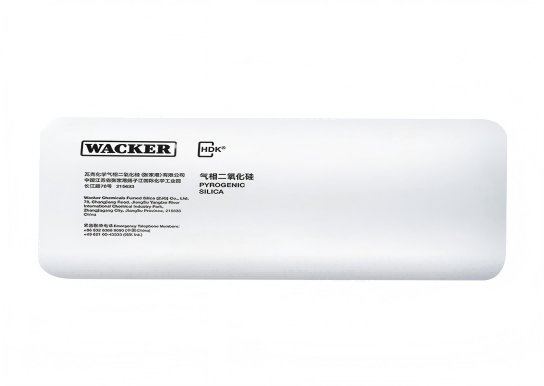
Features Of WACKER Hydrophilic Fumed Silica HDK S13
High Purity: >99.8% SiO₂ content with <1% moisture (105°C)
Rheology Control: Reduces pigment settling by 50% in solvent systems
Silicone Reinforcement: Boosts HTV rubber tensile strength by 30%
pH Stability: 3.8-4.3 in 4% aqueous dispersion (DIN EN ISO 787-9)
Low Residue: <0.03% sieve residue (>40μm) for uniform dispersio
Typical Applications Of WACKER Hydrophilic Fumed Silica HDK S13
Silicone Sealants: RTV-1K thickening and storage stability
Industrial Coatings: Anti-sagging in epoxy/polyurethane paints
Printing Inks: Rheology modifier for flexographic/offset inks
Cable Gels: Dielectric enhancer in insulation materials
Specifications Of WACKER Hydrophilic Fumed Silica HDK S13
BET - Surface Area | DIN 66131 | m²/g | 170 - 230 |
pH of 4% Dispersion | DIN ISO 787/9 | - | 3.8 - 4.3 |
Filling Density | DIN ISO 787/11 | g/l | approx. 40 |
Loss on Drying (105℃, 2h) | DIN ISO 787/2 | % | <1.5 |
Sieve Residue (according to Mocker >40μm) | DIN ISO 787/18 | % | <0.04 |
WACKER Hydrophilic Fumed Silica HDK S13 – Frequently Asked Questions (FAQ)
Q1: What is the primary functional role of HDK® S13 in liquid systems?
A: HDK® S13 acts primarily as a rheology modifier—providing thixotropic behavior, anti-sagging properties, and improved suspension stability in coatings, adhesives, sealants, and liquid composites. Its high surface area and hydrophilic nature enable strong hydrogen bonding with polar media.
Q2: How does HDK® S13 differ from hydrophobic fumed silica grades?
A: Unlike hydrophobic grades, HDK® S13 retains surface silanol groups, making it readily dispersible in water and polar solvents without requiring pre-treatment. It is not suitable for non-polar systems unless surface-modified or used with compatible dispersants.
Q3: What are key considerations for optimal dispersion of HDK® S13?
A: Effective dispersion typically requires high-shear mixing or ultrasonication to break agglomerates. Pre-wetting with part of the liquid phase or gradual addition under agitation helps prevent dusting and ensures uniform distribution. Avoid prolonged low-shear mixing, which may lead to incomplete deagglomeration.
Q4: Is HDK® S13 suitable for food-contact or pharmaceutical applications?
A: HDK® S13 is not certified for direct food-contact or pharmaceutical use. It is intended for industrial applications such as construction materials, industrial coatings, and technical elastomers. For regulated applications, consult WACKER’s dedicated food-grade or pharma-compliant silica products.
Q5: What typical dosage range is recommended for achieving desired rheological effects?
A: Dosage depends on formulation requirements and target viscosity, but HDK® S13 is typically used at low concentrations—generally ranging from 0.1% to 2% by weight—depending on the base medium polarity, shear history, and desired structural strength.
 English
 Español
 tiếng việt
 русский