English
 Español
 tiếng việt
 русский
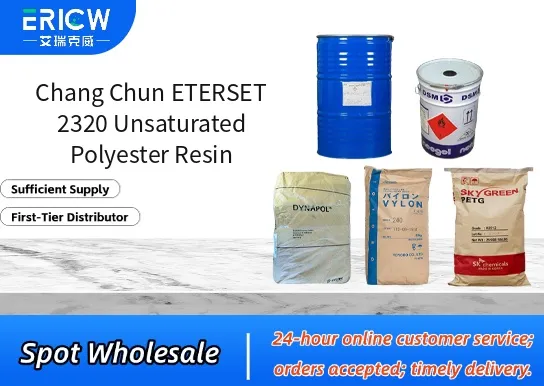
Excellent mechanical strength and dimensional stability after curing.
Good compatibility with standard MEKP initiators and low-profile additives.
Low viscosity for enhanced fiber wet-out and improved processability in RTM and hand lay-up.
Superior weather resistance and UV stability in outdoor applications.
Consistent batch-to-batch performance ensured by Chang Chun’s stringent quality control system.
Fiberglass-reinforced plastic (FRP) tanks and chemical storage vessels.
Marine hulls, decks, and structural components.
Automotive body panels and under-hood composite parts.
Wind turbine blade shells and nacelle covers.
Architectural cladding, translucent roofing, and decorative panels.
| Chemical Type | Orthophthalic unsaturated polyester resin |
| Product Form | Liquid, ready-to-use |
| Appearance | Clear to pale yellow viscous liquid |
| Viscosity (25°C, mPa·s) | 350–450 |
| Gel Time (with 1.0% MEKP, 25°C, min) | 18–25 |
| Solid Content (% w/w) | 99.5–100.0 |
| Density (25°C, g/cm³) | 1.12–1.16 |
| Reactive Diluent | Styrene (35–40% w/w) |
Q1: What are the primary curing systems compatible with ETERSET 2320?
A: ETERSET 2320 is designed for free-radical polymerization and is typically cured using organic peroxides such as methyl ethyl ketone peroxide (MEKP) or benzoyl peroxide (BPO), often in combination with cobalt or amine accelerators. Selection of initiator and accelerator should be based on required gel time, ambient conditions, and end-use performance requirements.
Q2: How does ETERSET 2320 perform in terms of chemical resistance and mechanical strength after curing?
A: When properly cured, ETERSET 2320 delivers good resistance to dilute acids, alkalis, and common solvents, along with balanced tensile and flexural strength suitable for structural laminates and molded components. Performance may vary depending on reinforcement type, filler content, and post-cure conditions.
Q3: Can ETERSET 2320 be used in high-humidity or outdoor applications?
A: Yes — ETERSET 2320 exhibits low moisture absorption and good weathering stability when formulated with UV stabilizers and pigmented fillers. For long-term outdoor exposure, it is recommended to apply a protective gel coat or topcoat to enhance surface durability and gloss retention.
Q4: Is ETERSET 2320 suitable for contact-molding and resin transfer molding (RTM) processes?
A: Yes — its controlled viscosity and reactivity profile make it well-suited for both contact molding and closed-mold processes like RTM and vacuum infusion. Adjustments to initiator concentration and temperature can optimize flow behavior and demold time without compromising final part integrity.
Contact With Us:
E-mail: wangxingqiang@ericwchem.com
Have a Questions? Call Us:
Add:
Building A1, Jiete Industrial Park, Huangpu District, Guangzhou City, Guangdong Province, China