English
 Español
 tiếng việt
 русский
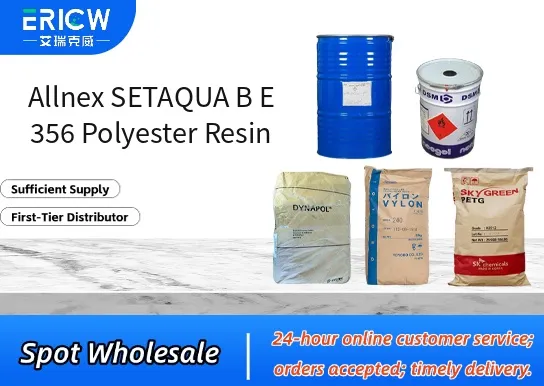
Waterborne polyester dispersion offering excellent hydrolytic stability and low VOC content.
Designed for high-gloss, durable clearcoats with superior film hardness and scratch resistance.
Enables fast ambient or low-bake curing (e.g., 60–80 °C), supporting energy-efficient production.
Provides outstanding compatibility with melamine formaldehyde crosslinkers and common additives.
Delivers balanced flexibility and chemical resistance for demanding industrial finishing applications.
Automotive OEM clearcoats and refinish topcoats.
Industrial wood coatings for furniture and cabinetry.
Metal finishing for appliances and architectural metal components.
Plastic coatings requiring adhesion, clarity, and mar resistance.
| Chemical Type | Waterborne saturated polyester dispersion |
| Product Form | Liquid dispersion (aqueous) |
| Appearance | Clear to slightly hazy, colorless to pale yellow liquid |
| pH (at 25 °C) | 7.5 – 8.5 |
| Solids Content (wt%) | 35 – 37% |
| Viscosity (mPa·s, Brookfield RVT, #2 spindle, 20 rpm) | 150 – 400 |
| Particle Size (D50, nm) | 80 – 120 |
| Primary Applications | High-performance waterborne clearcoats and topcoats |
Q1: What is the primary application of SETAQUA B E 356 in waterborne coatings?
A: SETAQUA B E 356 is a hydrophobic, low-VOC polyester resin designed to enhance film formation, hardness development, and chemical resistance in waterborne industrial maintenance and protective coatings—particularly where balanced drying speed and mechanical performance are required.
Q2: Is SETAQUA B E 356 compatible with common waterborne acrylic dispersions and polyurethane dispersions?
A: Yes, it demonstrates good compatibility with a broad range of waterborne acrylics, PUDs, and hybrid systems. Compatibility should be verified experimentally in the final formulation due to sensitivity to pH, ionic strength, and particle size distribution.
Q3: How does SETAQUA B E 356 contribute to film properties in cured coatings?
A: It promotes improved crosslink density and hydrophobic character in the cured film, leading to enhanced resistance to water spotting, alkali exposure, and abrasion—without significantly compromising flexibility or adhesion on common substrates.
Q4: What are recommended storage conditions for this resin?
A: Store in tightly sealed original containers at temperatures between 5 °C and 30 °C, away from direct sunlight and freezing conditions. Prolonged exposure to high humidity or temperature extremes may affect viscosity stability and dispersion behavior.
Contact With Us:
E-mail: wangxingqiang@ericwchem.com
Have a Questions? Call Us:
Add:
Building A1, Jiete Industrial Park, Huangpu District, Guangzhou City, Guangdong Province, China