English
 Español
 tiếng việt
 русский
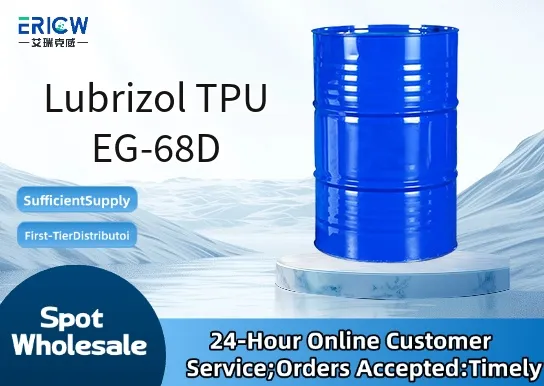
Excellent abrasion resistance for demanding mechanical environments.
Good low-temperature flexibility down to –30 °C.
Outstanding oil and grease resistance compared to conventional elastomers.
High tensile strength and elongation at break for dynamic part performance.
Compatible with common thermoplastic processing methods including extrusion and injection molding.
Automotive interior trim components requiring durability and soft-touch feel.
Industrial hoses and fluid transfer tubing exposed to oils and solvents.
Consumer electronics protective casings and wearable device straps.
Medical tubing and non-invasive device components meeting ISO 10993 biocompatibility screening requirements.
Footwear midsoles and outsoles where resilience and energy return are critical.
| Chemical Type | Aliphatic polyester-based thermoplastic polyurethane |
| Product Form | Pellets |
| Appearance | Off-white to light tan, free-flowing pellets |
| Shore A Hardness (ASTM D2240) | 68 ± 2 |
| Tensile Strength (ASTM D412) | 35–42 MPa |
| Elongation at Break (ASTM D412) | 550–650 % |
| Melt Flow Rate (230 °C / 2.16 kg, ASTM D1238) | 10–14 g/10 min |
| Density (ASTM D792) | 1.18–1.20 g/cm³ |
Q1: What is Lubrizol TPU EG-68D primarily used for?
A: Lubrizol TPU EG-68D is a high-performance thermoplastic polyurethane-based processing aid designed to enhance melt flow, reduce extrusion pressure, and improve surface finish in rigid PVC compounds—particularly in applications such as window profiles, pipe, and siding.
Q2: Is EG-68D compatible with common PVC stabilizer systems?
A: Yes, EG-68D demonstrates broad compatibility with calcium–zinc, lead-based, and organotin stabilizers commonly used in rigid PVC formulations. It does not interfere with thermal stability or long-term aging performance when incorporated at recommended levels.
Q3: How should EG-68D be incorporated into PVC compound formulations?
A: EG-68D is typically added during the high-speed mixing stage alongside other dry additives. It disperses readily in PVC resin and does not require pre-dilution or special handling—standard hot-mix procedures apply.
Q4: Does EG-68D affect the mechanical properties of finished PVC products?
A: When used within typical dosage ranges, EG-68D maintains key mechanical properties—including tensile strength, impact resistance, and modulus—while significantly improving processability. No adverse effects on long-term weathering or dimensional stability have been observed in validated formulations.
Q5: Can EG-68D be used in food-contact or potable water applications?
A: EG-68D is not specifically certified for food-contact or drinking water applications. Formulators intending such use must conduct full regulatory evaluation—including migration testing and compliance verification against applicable regional requirements—prior to commercial deployment.
Contact With Us:
E-mail: wangxingqiang@ericwchem.com
Have a Questions? Call Us:
Add:
Building A1, Jiete Industrial Park, Huangpu District, Guangzhou City, Guangdong Province, China