English
 Español
 tiếng việt
 русский
Excellent balance of elasticity and tensile strength for dynamic part performance.
Good processability on standard injection molding and extrusion equipment.
Enhanced resistance to UV exposure and thermal aging under ambient conditions.
Low compression set for reliable sealing and gasketing functionality over time.
Compatible with polypropylene (PP) and polyethylene (PE) for co-molding applications.
Automotive interior trim components including soft-touch armrests and console covers.
Consumer electronics housings and protective overmolded grips for power tools.
Household appliance seals, gaskets, and flexible knobs requiring tactile feedback.
Medical device enclosures and non-sterile ergonomic handles compliant with ISO 10993-5.
Industrial fluid-handling components such as low-pressure hose connectors and valve boots.
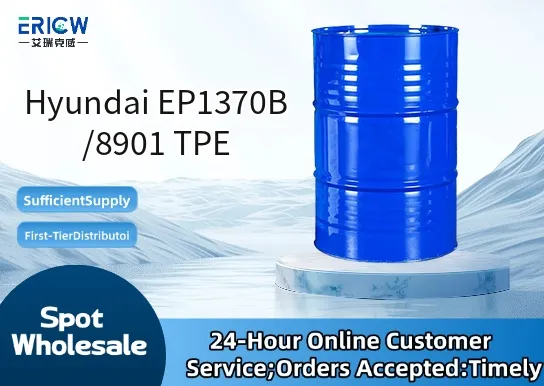
| Chemical Type | Thermoplastic Elastomer (TPE) – PP-based thermoplastic vulcanizate (TPV) |
| Product Form | Pellets |
| Appearance | Off-white to light beige, uniform cylindrical pellets |
| Primary Applications | Overmolding, soft-touch surfaces, dynamic seals, and flexible structural parts |
| Key Features | Elastic recovery, PP compatibility, good flow characteristics, UV-stabilized |
| Benefits | Reduced assembly steps, recyclable processing, no vulcanization required, RoHS-compliant formulation |
| Processing Method | Injection molding, extrusion, two-shot molding |
| Standard Packaging | 25 kg multi-wall paper bags with polyethylene liner |
Q1: What is the primary application domain for Hyundai EP1370B/8901 TPE?
A: Hyundai EP1370B/8901 TPE is primarily engineered for soft-touch overmolding and functional elastomeric components in automotive interior systems, including control knobs, gear shift boots, and trim accents requiring consistent tactile response and long-term dimensional stability.
Q2: Is this grade suitable for two-shot injection molding with common thermoplastics?
A: Yes — EP1370B/8901 TPE exhibits strong adhesion to polypropylene (PP), polyethylene (PE), and ABS substrates without requiring primers or surface treatment under standard processing conditions, making it well-suited for two-shot and multi-material molding processes.
Q3: How does this TPE perform under elevated temperature exposure typical in automotive cabins?
A: The formulation offers enhanced thermal resistance compared to conventional SEBS-based TPEs, maintaining elasticity and surface integrity during prolonged exposure to temperatures commonly encountered in vehicle interiors (e.g., dashboard environments), with minimal compression set and reduced tendency to bloom or soften.
Q4: What are the key processing advantages of EP1370B/8901 TPE?
A: It features a relatively low melt viscosity and narrow processing window, enabling short cycle times, excellent flow into fine details, and reduced risk of flashing — particularly beneficial for high-precision automotive parts with tight tolerances and complex geometries.
Contact With Us:
E-mail: wangxingqiang@ericwchem.com
Have a Questions? Call Us:
Add:
Building A1, Jiete Industrial Park, Huangpu District, Guangzhou City, Guangdong Province, China