English
 Español
 tiếng việt
 русский
Excellent abrasion resistance for demanding mechanical environments.
Outstanding low-temperature flexibility down to –40 °C.
Good hydrolysis resistance, suitable for humid or wet-condition applications.
High melt flow index enabling efficient processing via extrusion and injection molding.
Consistent batch-to-batch performance with tight quality control per Lubrizol’s ISO 9001 manufacturing standards.
Automotive interior trim components including door panels and instrument bezels.
Flexible industrial hoses and pneumatic tubing requiring kink resistance.
Wear-resistant protective covers for electronic enclosures and medical device housings.
High-clarity, soft-touch overmolding on rigid substrates such as ABS and PC.
Consumer goods casings for power tools and handheld appliances.
| Chemical Type | Thermoplastic Polyurethane (Aliphatic Polyester-based) |
| Product Form | Pellets |
| Appearance | Off-white, free-flowing granules |
| Primary Applications | Overmolding, extruded profiles, injection-molded functional parts |
| Key Features | Abrasion resistance, low-temperature toughness, processability |
| Benefits | Reduced part wear, design freedom for soft-touch interfaces, compatibility with standard TPU processing equipment |
| Density (g/cm³) | 1.18–1.20 |
| Melt Flow Index (230 °C/2.16 kg, g/10 min) | 12–16 |
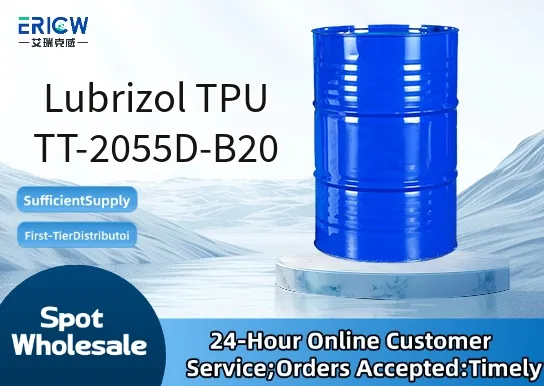
Q1: What is the primary function of Lubrizol TPU TT-2055D-B20 in thermoplastic polyurethane (TPU) formulations?
A: Lubrizol TPU TT-2055D-B20 is a specialized processing aid and surface modifier designed to improve melt flow, reduce extrusion die buildup, and enhance surface gloss and clarity in TPU compounds—particularly in demanding applications such as thin-gauge films and precision extrusions.
Q2: Is TT-2055D-B20 compatible with aromatic and aliphatic TPU base resins?
A: Yes, TT-2055D-B20 demonstrates broad compatibility across both aromatic and aliphatic TPU systems. Its molecular design enables stable dispersion without phase separation or adverse effects on mechanical properties under typical processing conditions.
Q3: How should TT-2055D-B20 be incorporated into TPU processing?
A: It is typically introduced via masterbatch dilution or direct dry-blend addition prior to extrusion or injection molding. Pre-drying is not required, and it remains thermally stable during standard TPU processing temperatures up to 220 °C.
Q4: Does TT-2055D-B20 affect the final TPU’s mechanical performance or thermal stability?
A: When used within recommended dosage ranges, TT-2055D-B20 does not significantly compromise tensile strength, elongation, or heat resistance. In fact, improved melt homogeneity may contribute to more consistent mechanical behavior across production batches.
Contact With Us:
E-mail: wangxingqiang@ericwchem.com
Have a Questions? Call Us:
Add:
Building A1, Jiete Industrial Park, Huangpu District, Guangzhou City, Guangdong Province, China