English
 Español
 tiếng việt
 русский
Excellent melt processability for high-speed extrusion and injection molding
Superior low-temperature flexibility and impact resistance down to –40 °C
Outstanding sealing performance with broad heat-seal initiation and strong seal integrity
Good compatibility with polyolefins, enabling effective blending with PP and PE
Low extractables and excellent clarity—ideal for food-contact and medical-grade applications
Flexible packaging films—including stand-up pouches and retortable laminates
Automotive interior trim components requiring soft-touch feel and durability
Sealant layers in multilayer coextruded food packaging structures
Medical tubing and soft-grip overmolding for handheld devices
Weather-resistant elastomeric profiles for building and construction seals
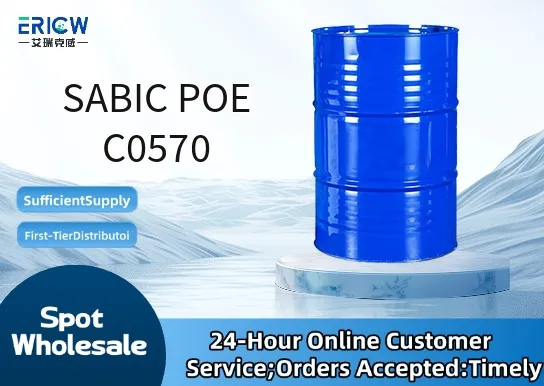
| Chemical Type | Polyolefin Elastomer (POE), ethylene-octene copolymer |
| Product Form | Natural-colored pellets |
| Appearance | Free-flowing, translucent to semi-crystalline granules |
| Primary Applications | Flexible packaging, soft-touch overmolding, sealant layers |
| Key Features | Low modulus, high elasticity, excellent process stability |
| Benefits | Reduced energy consumption during processing; improved part toughness and aesthetics |
| Regulatory Compliance | Meets FDA 21 CFR §177.1520 for food contact; compliant with EU Regulation (EC) No. 1935/2004 |
| Processing Method | Extrusion, injection molding, blow molding, coextrusion |
Q1: What is the primary function of SABIC POE C0570 in polymer formulations?
A: SABIC POE C0570 is an ethylene-octene polyolefin elastomer designed primarily as a toughening agent and impact modifier for polypropylene (PP) and other polyolefin-based systems. It enhances low-temperature ductility, improves melt processability, and contributes to balanced stiffness-toughness performance without significantly compromising stiffness.
Q2: Is SABIC POE C0570 suitable for automotive interior applications?
A: Yes — it is widely used in automotive interior components such as instrument panels, door trims, and pillar covers due to its excellent low-temperature impact resistance, good surface finish, and compatibility with PP-based TPO compounds. Its low extractables profile supports compliance with typical automotive VOC and fogging requirements.
Q3: How does SABIC POE C0570 compare to EPDM or other POEs in terms of processing behavior?
A: Compared to traditional EPDM, SABIC POE C0570 offers narrower molecular weight distribution and higher long-chain branching, resulting in lower melt viscosity and improved shear sensitivity. This enables easier extrusion and injection molding, especially in thin-wall or complex geometries, while maintaining good dispersion in PP matrices.
Q4: What are typical dosage levels when using SABIC POE C0570 as an impact modifier?
A: Dosage depends on the base resin and target performance, but it is typically used at low concentrations ranging from 0.1% to 2% by weight for fine-tuning impact properties in homopolymer PP, and up to 20–30% in PP copolymer blends where enhanced toughness is critical.
Contact With Us:
E-mail: wangxingqiang@ericwchem.com
Have a Questions? Call Us:
Add:
Building A1, Jiete Industrial Park, Huangpu District, Guangzhou City, Guangdong Province, China