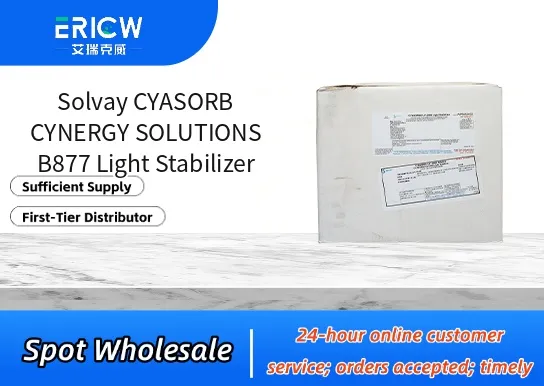
Features Of Solvay CYASORB CYNERGY SOLUTIONS B877 Light Stabilizer
Synergistic HALS–UV absorber blend delivering superior long-term UV protection in demanding outdoor applications.
Enhanced thermal and hydrolytic stability for improved processing safety and shelf life in polymer melts.
Low volatility and excellent compatibility with polyolefins, engineering thermoplastics, and elastomers.
Reduced extractability and migration, supporting compliance with stringent regulatory requirements (e.g., FDA, EU food contact).
Optimized for high-efficiency stabilization in thin-section parts and pigmented systems without surface blooming.
Typical Applications Of Solvay CYASORB CYNERGY SOLUTIONS B877 Light Stabilizer
Automotive exterior components (bumpers, grilles, trim)
Agricultural films and greenhouse covers
Geotextiles and civil engineering membranes
Outdoor furniture and decking profiles
Pigmented HDPE and PP blow-molded containers for outdoor storage
Specifications Of Solvay CYASORB CYNERGY SOLUTIONS B877 Light Stabilizer
| Chemical Type | Synergistic blend of hindered amine light stabilizer (HALS) and benzotriazole UV absorber |
| Product Form | Free-flowing granules |
| Appearance | Pale yellow to light beige granules |
| Primary Applications | Polyolefins (PP, HDPE, LDPE), engineering plastics (PA, PBT), TPOs, and thermoplastic elastomers |
| Key Features | High synergistic efficiency, low volatility, excellent melt stability, low extractability |
| Benefits | Extended service life under UV exposure, reduced color fade and embrittlement, simplified formulation |
| Recommended Loading Range | 0.1 – 0.5 wt% (depending on substrate and end-use requirements) |
| Storage Conditions | Store in original unopened packaging at ≤30°C, protected from moisture and direct sunlight |
Solvay CYASORB CYNERGY SOLUTIONS B877 Light Stabilizer – Frequently Asked Questions (FAQ)
Q1: What is the primary function of CYASORB CYNERGY SOLUTIONS B877 in polymer formulations?
A: CYASORB CYNERGY SOLUTIONS B877 is a synergistic light stabilizer system designed to provide enhanced protection against UV-induced degradation in polyolefins and other thermoplastics. It combines HALS (hindered amine light stabilizers) and UV absorbers to deliver superior long-term weatherability, especially under demanding outdoor exposure conditions.
Q2: Which polymer systems is B877 most commonly used in?
A: B877 is widely applied in polypropylene (PP), polyethylene (PE), and related copolymers—particularly in applications requiring high resistance to photo-oxidation, such as automotive interior parts, agricultural films, geotextiles, and outdoor consumer goods. Its liquid format facilitates uniform dispersion in melt-processing operations.
Q3: How does the liquid formulation of B877 benefit processing compared to solid stabilizers?
A: As a ready-to-use liquid solution, B877 eliminates handling and dust concerns associated with powders, enables precise metering via pump systems, improves mixing efficiency in extrusion or compounding, and supports consistent stabilization performance across batch runs—especially in high-speed or continuous manufacturing environments.
Q4: Is CYASORB CYNERGY SOLUTIONS B877 compatible with common polymer additives?
A: Yes, B877 demonstrates good compatibility with typical polyolefin additives including antioxidants (e.g., hindered phenols and phosphites), acid scavengers, and nucleating agents. However, formulation-specific compatibility testing is recommended when combining with highly reactive components such as certain peroxides or metal-based catalysts.
Q5: What is the typical dosage range for optimal performance?
A: Dosage depends on the polymer matrix, expected service life, and environmental stress level, but B877 is typically used at low concentrations—generally ranging from 0.1% to 2% by weight—based on total formulation mass. Final optimization should be determined through application-specific weathering and mechanical testing.
 English
 Español
 tiếng việt
 русский