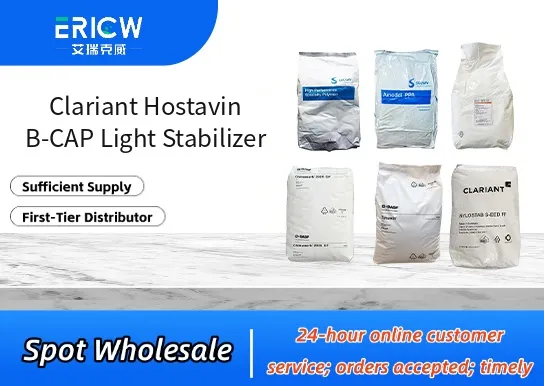
High-performance hindered amine light stabilizer (HALS) with synergistic thioether functionality for enhanced long-term UV resistance.
Excellent compatibility with polyolefins, including PP and HDPE, enabling uniform dispersion without blooming or migration.
Thermal stability up to 280 °C supports high-temperature processing such as injection molding and extrusion.
Low volatility and minimal odor, suitable for applications requiring low VOC emissions and improved workplace safety.
Resistant to extraction by polar solvents and aqueous media, ensuring durability in outdoor and demanding end-use environments.
Automotive interior and exterior plastic components exposed to sunlight and elevated temperatures.
Outdoor agricultural films and geomembranes requiring extended UV resistance and mechanical retention.
Polypropylene fibers and nonwovens used in geotextiles, upholstery, and technical textiles.
HDPE blow-molded containers for household and industrial chemicals where color stability is critical.
Rotomolded tanks and playground equipment subject to prolonged weathering and thermal cycling.
| Chemical Type | Hindered amine light stabilizer (HALS) with thioether co-stabilizer |
| Product Form | Pellets |
| Appearance | Off-white to light beige free-flowing pellets |
| Primary Applications | Polyolefins (PP, HDPE, LDPE), polypropylene fibers, and rotomolded products |
| Key Features | Synergistic HALS/thioether system, low volatility, high thermal stability |
| Benefits | Extended service life under UV exposure, reduced surface cracking and embrittlement, improved color retention |
| Recommended Loading Range | 0.1–0.5 wt% depending on substrate and performance requirements |
| Storage Conditions | Store in original unopened packaging at room temperature; protect from moisture and direct sunlight |
Q1: What is the primary mechanism of stabilization for CYASORB THT 4611?
A: CYASORB THT 4611 functions primarily as a hindered amine light stabilizer (HALS), operating through a regenerative radical scavenging mechanism that inhibits photo-oxidative degradation in polymers exposed to UV radiation and heat.
Q2: In which polymer systems is CYASORB THT 4611 most commonly used?
A: It is widely employed in polyolefins—including PP and HDPE—as well as engineering thermoplastics such as ABS, PC/ABS blends, and polyesters, where long-term outdoor stability and resistance to UV-induced embrittlement are critical.
Q3: How does CYASORB THT 4611 compare to low-molecular-weight HALS in terms of volatility and extraction resistance?
A: As a high-molecular-weight HALS, CYASORB THT 4611 offers reduced volatility and improved resistance to extraction and blooming compared to conventional low-MW HALS, making it especially suitable for demanding applications requiring extended service life under thermal or humid conditions.
Q4: Is CYASORB THT 4611 compatible with other common polymer additives?
A: Yes, it demonstrates good compatibility with typical polymer additives including antioxidants (e.g., phenolic and phosphite types), UV absorbers (e.g., benzotriazoles), and flame retardants—though synergistic or antagonistic interactions should be verified experimentally for specific formulations.
Q5: What is the typical dosage range for effective stabilization with CYASORB THT 4611?
A: Dosage depends on the polymer matrix, processing conditions, and end-use requirements, but it is typically used at low concentrations—generally ranging from 0.1% to 2% by weight—with optimal performance often achieved between 0.2% and 1.0% in polyolefin applications.
Contact With Us:
E-mail: wangxingqiang@ericwchem.com
Have a Questions? Call Us:
Add:
Building A1, Jiete Industrial Park, Huangpu District, Guangzhou City, Guangdong Province, China
 English
 Español
 tiếng việt
 русский