English
 Español
 tiếng việt
 русский
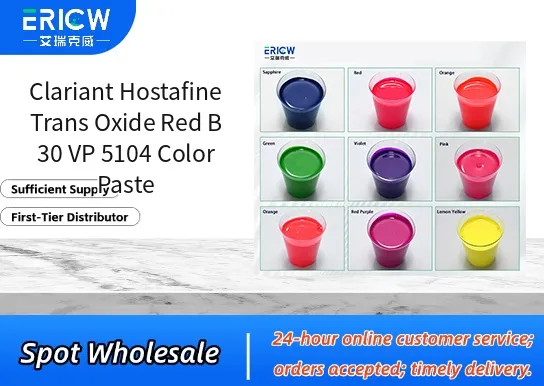
High chroma transparent red shade based on high-purity iron oxide pigment.
Excellent dispersion stability in polar and non-polar polymer systems.
Good thermal stability up to 220 °C for processing in polyolefins and engineering plastics.
Low volatility and minimal plate-out tendency during extrusion and injection molding.
Compliant with global food-contact regulations (EU 10/2011, FDA 21 CFR §178.3290) when used at approved levels.
Polypropylene (PP) and polyethylene (PE) packaging films requiring transparent red tinting.
Transparent rigid containers for cosmetics and household products.
Medical device housings requiring biocompatible, non-leaching coloration.
Automotive interior trim components demanding long-term UV and heat resistance.
Food-grade plastic caps, closures, and dispensing systems.
| Chemical Type | Iron oxide-based organic-inorganic hybrid pigment dispersion |
| Product Form | Viscous liquid color paste (non-aqueous) |
| Appearance | Homogeneous red paste, free of grit or sediment |
| Primary Applications | Polyolefins, PET, PS, ABS, and thermoplastic elastomers |
| Key Features | Transparency, thermal stability, low migration, regulatory compliance |
| Recommended Loading Range | 0.5–3.0 wt% depending on substrate and required shade depth |
| VOC Content | <1.0 wt% (as per ISO 11890-2) |
| Storage Conditions | Store at 10–30 °C; protect from freezing and direct sunlight |
Q1: What types of polymer systems is this color paste compatible with?
A: Clariant Hostafine Trans Oxide Red B 30 VP 5104 is formulated for use in thermoplastic polymers including polyolefins (PP, PE), PS, ABS, and certain engineering plastics. It is not recommended for high-temperature processing above 280 °C or for applications requiring long-term UV stability without additional stabilization.
Q2: How should this color paste be incorporated into the base polymer?
A: The paste is typically introduced via gravimetric or volumetric dosing directly into the extruder feed throat or hopper. Pre-blending with a portion of the base resin prior to extrusion can improve dispersion uniformity. Avoid high-shear pre-mixing that may cause premature pigment agglomeration.
Q3: Is this product suitable for food-contact or medical-grade applications?
A: This grade is not certified for direct food contact or medical device applications. Customers requiring regulatory compliance must consult Clariant’s technical service team for documentation supporting specific regional requirements and verify suitability within their final formulation and processing conditions.
Q4: What is the typical dosage range for achieving full opacity or strong transparency effects?
A: As a transparent oxide red, it delivers strong chroma at low loadings. For transparent tints, dosage generally ranges from 0.1% to 2% by weight depending on substrate thickness and desired intensity. For semi-opaque effects, higher concentrations may be used—but always evaluate dispersion quality and thermal stability in the target process.
Contact With Us:
E-mail: wangxingqiang@ericwchem.com
Have a Questions? Call Us:
Add:
Building A1, Jiete Industrial Park, Huangpu District, Guangzhou City, Guangdong Province, China