English
 Español
 tiếng việt
 русский
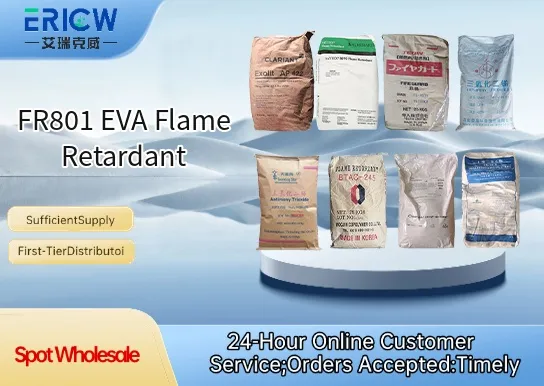
Halogen-free formulation for low smoke and zero corrosive gas emission during combustion.
Excellent compatibility with ethylene-vinyl acetate (EVA) copolymer matrices without compromising mechanical properties.
High thermal stability, maintaining performance up to 280 °C during processing.
UL 94 V-0 rated when compounded at recommended loading levels in EVA-based formulations.
Low volatility and minimal plate-out tendency during extrusion and injection molding.
Solar photovoltaic module encapsulants requiring fire-safe, transparent EVA films.
Wire and cable jacketing for low-smoke, halogen-free flame-retardant applications.
Fire-resistant flooring underlayment and acoustic mats based on EVA blends.
Flame-retardant gaskets and seals in transportation and building interiors.
Hot-melt adhesives for fire-rated construction assemblies.
| Chemical Type | Organophosphorus-based synergistic flame retardant |
| Product Form | Free-flowing white granules |
| Appearance | Off-white to light beige granules, uniform particle size |
| Density (25 °C) | 1.35–1.42 g/cm³ |
| Melting Range | 165–175 °C |
| Moisture Content | ≤0.2 wt% (by Karl Fischer titration) |
| pH (10% aqueous dispersion) | 6.5–7.5 |
| Recommended Loading Level in EVA | 18–25 phr (parts per hundred rubber) |
Q1: What is the primary mechanism of flame retardancy for FR801 in EVA compounds?
A: FR801 functions primarily through a condensed-phase mechanism, promoting char formation and reducing the release of combustible volatiles during thermal decomposition—enhancing the inherent fire resistance of ethylene-vinyl acetate (EVA) matrices without relying on halogenated chemistry.
Q2: Is FR801 compatible with common EVA processing methods such as extrusion and injection molding?
A: Yes, FR801 is specifically formulated for excellent thermal stability and dispersion in EVA, making it suitable for standard melt-processing techniques including single- and twin-screw extrusion, calendering, and injection molding—without significant degradation or plate-out issues under typical processing conditions.
Q3: How does FR801 affect the mechanical and electrical properties of EVA insulation or cable jacketing compounds?
A: When properly compounded, FR801 maintains good balance between flame retardancy and key performance attributes—retaining acceptable tensile strength, elongation at break, and volume resistivity. It does not introduce significant ionic impurities or adversely impact long-term aging behavior in low-voltage cable applications.
Q4: Can FR801 be used in combination with other additives like smoke suppressants or synergists?
A: Yes, FR801 demonstrates good compatibility with common co-additives such as metal hydroxides (e.g., ATH, MDH), phosphinate-based synergists, and organic smoke suppressants—enabling formulators to fine-tune smoke density, afterglow, and overall fire performance without compromising processability.
Contact With Us:
E-mail: wangxingqiang@ericwchem.com
Have a Questions? Call Us:
Add:
Building A1, Jiete Industrial Park, Huangpu District, Guangzhou City, Guangdong Province, China