English
 Español
 tiếng việt
 русский
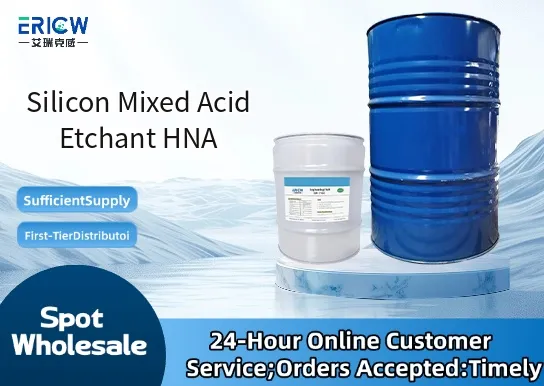
Precisely formulated 3-component mixture of hydrofluoric acid (HF), nitric acid (HNO₃), and acetic acid (CH₃COOH) for controlled, isotropic silicon etching.
Offers exceptional etch rate uniformity across <100> and <111> silicon crystal planes with minimal undercutting.
Stable composition with low volatility and reduced fuming compared to conventional HF/HNO₃ blends.
Engineered for reproducible process control in automated wet benches and batch etching systems.
Supplied with comprehensive SDS and lot-specific analytical certificates for traceability and quality assurance.
Release etching of MEMS structures (e.g., accelerometers, gyroscopes, micro-mirrors) in silicon-on-insulator (SOI) wafers.
Bulk micromachining of pressure sensor diaphragms and fluidic channels in single-crystal silicon substrates.
Surface texturing and defect removal during pre-bonding wafer cleaning and polishing preparation.
Controlled thinning of silicon wafers for advanced packaging applications including TSV and fan-out wafer-level packaging (FOWLP).
Research-scale fabrication of photonic integrated circuits (PICs) requiring high-fidelity sidewall morphology.
| Chemical Type | Aqueous mixed acid solution (HF/HNO₃/CH₃COOH) |
| Product Form | Liquid, ready-to-use concentrate |
| Appearance | Clear, colorless to pale yellow liquid |
| Primary Applications | Isotropic silicon etching, MEMS release, bulk micromachining |
| Key Features | Controlled etch rate (1.5–4.0 µm/min at 20°C), low particulate generation, stable shelf life (≥12 months unopened) |
| Benefits | Reduced process variability, compatibility with quartz and PTFE handling components, minimal post-etch residue |
| Regulatory Compliance | REACH compliant; supplied with full SDS per GHS Rev.10; not classified as PBT/vPvB |
| Storage Requirement | Store at 10–25°C in original HDPE or fluoropolymer-lined container; protect from light and moisture |
| Common Compatible Systems | Suitability |
| Quartz immersion baths with PTFE-coated heaters and recirculation pumps | Highly Recommended – Chemically inert and thermally stable under standard operating conditions |
| Automated wet bench platforms (e.g., SEMI-compliant tools from SCREEN, Tokyo Electron, or STS) | Highly Recommended – Validated for integration with temperature-controlled spray/nozzle modules and real-time concentration monitoring |
| Manual dip tanks fabricated from polypropylene (PP) or PVDF | Recommended – Requires strict temperature control and periodic replacement due to potential slow leaching |
| Glassware (borosilicate) for R&D-scale use | Suitable – Only for short-term (<15 min), room-temperature etching; not recommended for extended exposure or heating |
Q1: What is the CAS Registry Number for Silicon Mixed Acid Etchant HNA?
A: This is a proprietary multi-component formulation; individual CAS numbers apply to constituents only (HF: 7664-39-3; HNO₃: 7697-37-2; Acetic Acid: 64-19-7). The blended product does not carry a unique CAS number per IUPAC and regulatory guidance for mixtures.
Q2: What is the recommended working concentration and typical etch rate range?
A: Supplied as a ready-to-use concentrate. Typical etch rate on (100) Si is 2.2–3.5 µm/min at 20°C; rate increases ~12% per °C rise. Dilution is not recommended — performance validation is based on undiluted use per manufacturer specifications.
Q3: How does HNA compare to BOE (Buffered Oxide Etch) in terms of silicon selectivity and surface roughness?
A: HNA exhibits significantly higher silicon etch rate and lower SiO₂:Si selectivity (~1:100) versus BOE (~1:500), making it unsuitable for oxide-masked patterning but ideal for bulk silicon removal. Surface roughness (Ra) remains ≤0.8 nm after HNA etching, comparable to BOE when used within optimal temperature windows.
Q4: Are there restrictions regarding extractables or metallic impurities for semiconductor-grade use?
A: Yes — certified to SEMI C12 (≤10 ppt Na, K, Ca, Fe, Cu, Ni, Cr, Zn) and ≤50 ppt total metals by ICP-MS. Extractables testing per USP <661.1> confirms compliance for Class VI polymer contact systems used in tool wetted parts.
Contact With Us:
E-mail: wangxingqiang@ericwchem.com
Have a Questions? Call Us:
Add:
Building A1, Jiete Industrial Park, Huangpu District, Guangzhou City, Guangdong Province, China