English
 Español
 tiếng việt
 русский
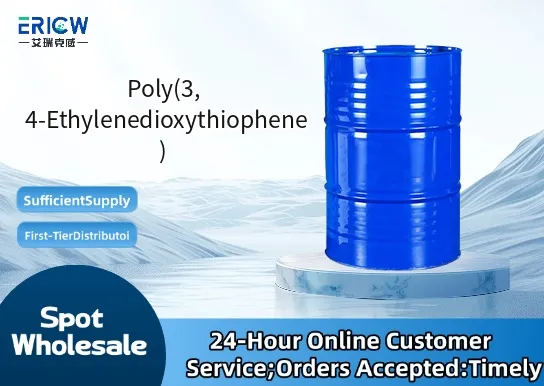
Exceptional electrical conductivity (up to 100–600 S/cm when doped with PSS) with long-term ambient stability.
High optical transparency in the visible and near-infrared range, enabling use in transparent conductive layers.
Outstanding environmental stability—resistant to oxidation, moisture, and thermal degradation up to 200 °C.
Excellent film-forming capability via spin-coating, inkjet printing, or spray deposition on diverse substrates.
Tunable work function (~4.9–5.2 eV), facilitating efficient charge injection in organic electronic devices.
Transparent conductive electrodes for OLEDs, OPVs, and flexible touch sensors.
Hole transport layer (HTL) in perovskite solar cells and organic photovoltaics.
Antistatic coatings for packaging films, display components, and medical device housings.
Biosensor transducers leveraging its biocompatibility and redox activity for glucose and dopamine detection.
Electrochromic layers in smart windows and low-power displays due to rapid, reversible color switching.
| Chemical Type | Conducting polymer (p-type semiconductor) |
| Product Form | Aqueous dispersion (e.g., PEDOT:PSS, typically 1.0–1.3 wt% solids) |
| Appearance | Opaque bluish-gray to dark blue liquid (pH ~1.5–2.5) |
| Melting Point | Decomposes above ~250 °C; no sharp melting point |
| Primary Applications | Transparent electrodes, HTLs, antistatic coatings, electrochromics |
| Key Features | High conductivity, solution processability, ambient stability, tunable work function |
| Benefits | Enables roll-to-roll manufacturing, reduces ITO dependency, improves device lifetime |
| Regulatory Compliance | REACH registered; RoHS compliant; no SVHCs above threshold per latest update |
| Common Compatible Systems | Suitability |
| Poly(styrene sulfonate) (PSS) | Highly Recommended – Standard dopant and dispersant for aqueous PEDOT formulations |
| Isopropanol / Ethanol co-solvents | Recommended – Enhances film uniformity and conductivity upon post-treatment |
| UV-Ozone or oxygen plasma treated ITO/PET/ glass | Highly Recommended – Improves interfacial adhesion and reduces contact resistance |
| Acidic additives (e.g., H₂SO₄, p-toluenesulfonic acid) | Recommended – Boosts conductivity via secondary doping and phase separation control |
Q1: What is the CAS Number for Poly(3,4-ethylenedioxythiophene)?
A: The CAS Registry Number for Poly(3,4-ethylenedioxythiophene) is 155099-74-0. Note that commercial dispersions (e.g., PEDOT:PSS) are complex mixtures and do not carry a single CAS number.
Q2: What is the typical recommended coating thickness for optimal conductivity and transparency?
A: For spin-coated PEDOT:PSS films, a dry thickness of 30–60 nm delivers optimal balance of sheet resistance (< 100 Ω/sq) and >85% visible-light transmission at 550 nm.
Q3: How does PEDOT compare to polyaniline (PANI) or polypyrrole (PPy) in terms of processability and stability?
A: PEDOT exhibits superior ambient oxidative stability and higher conductivity than PANI or PPy, and unlike PPy, it forms stable aqueous dispersions without requiring in-situ polymerization — enabling direct solution processing.
Q4: Is PEDOT:PSS suitable for food-contact or medical-grade applications?
A: Standard PEDOT:PSS dispersions are not certified for direct food contact or implantable medical use. However, specific grades meeting USP Class VI and ISO 10993-5 cytotoxicity requirements are available upon request and qualification.
Q5: Does PEDOT exhibit migration or leaching under humid or elevated-temperature conditions?
A: Fully dried and crosslinked PEDOT:PSS films show negligible small-molecule migration; however, residual PSS and surfactants may extract under prolonged high-humidity (>85% RH) or aqueous immersion — mitigation strategies include thermal annealing and additive-based crosslinking.
Contact With Us:
E-mail: wangxingqiang@ericwchem.com
Have a Questions? Call Us:
Add:
Building A1, Jiete Industrial Park, Huangpu District, Guangzhou City, Guangdong Province, China