English
 Español
 tiếng việt
 русский
Excellent abrasion resistance for demanding mechanical service life.
Outstanding oil and grease resistance suitable for industrial environments.
Good low-temperature flexibility down to –30 °C without brittle failure.
High tensile strength and elongation at break for dynamic load-bearing applications.
Easy processability via extrusion, injection molding, and calendering.
Industrial rollers and conveyor belts requiring wear resilience.
Automotive trim components and interior soft-touch parts.
High-performance cables and jacketing for flexible wiring systems.
Footwear midsoles and outsoles demanding rebound and durability.
Medical tubing and non-implantable fluid-handling devices.
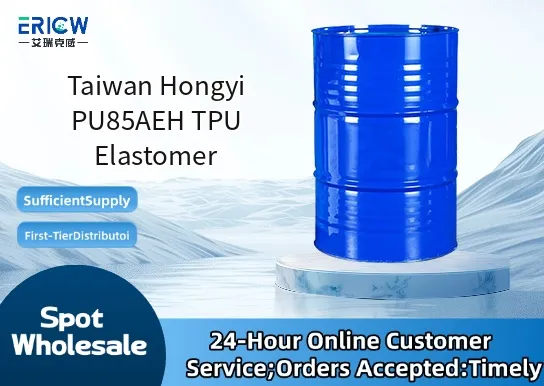
| Chemical Type | Aliphatic Polyester-Based Thermoplastic Polyurethane |
| Product Form | Pellets |
| Appearance | Off-white to light yellow translucent granules |
| Hardness (Shore A) | 85 ± 2 |
| Melt Flow Index (210 °C/5 kg) | 12–16 g/10 min |
| Tensile Strength (ASTM D412) | ≥ 38 MPa |
| Elongation at Break (ASTM D412) | ≥ 550 % |
| Density (ASTM D792) | 1.18–1.20 g/cm³ |
Q1: What is the primary functional role of PU85AEH in TPU formulations?
A: PU85AEH is a reactive polyurethane-based elastomer modifier designed to enhance melt processability and improve low-temperature flexibility in thermoplastic polyurethane (TPU) compounds, particularly in extrusion and injection molding applications.
Q2: Is PU85AEH compatible with aromatic and aliphatic TPU base resins?
A: Yes, PU85AEH demonstrates broad compatibility with both aromatic and aliphatic TPU systems, supporting uniform dispersion and stable phase morphology without requiring additional compatibilizers in most standard formulations.
Q3: How does PU85AEH affect the mechanical properties of finished TPU parts?
A: When incorporated at typical dosage levels, PU85AEH helps maintain tensile strength and elongation while significantly improving impact resistance and dynamic fatigue performance—especially under repeated flexing or low-temperature conditions.
Q4: What processing methods are recommended for optimal performance with PU85AEH-modified TPU?
A: PU85AEH is especially effective in melt-processing techniques such as twin-screw compounding, film extrusion, and thin-wall injection molding, where its low-melt-viscosity character supports improved flow and surface finish without degrading thermal stability.
Q5: Does PU85AEH require drying prior to processing?
A: Yes—like most hygroscopic TPU modifiers, PU85AEH should be dried to a moisture content below 0.05% before processing, typically using hot-air or desiccant dryers at 70–80 °C for 2–4 hours, to prevent surface defects and ensure consistent rheological behavior.
Contact With Us:
E-mail: wangxingqiang@ericwchem.com
Have a Questions? Call Us:
Add:
Building A1, Jiete Industrial Park, Huangpu District, Guangzhou City, Guangdong Province, China