English
 Español
 tiếng việt
 русский
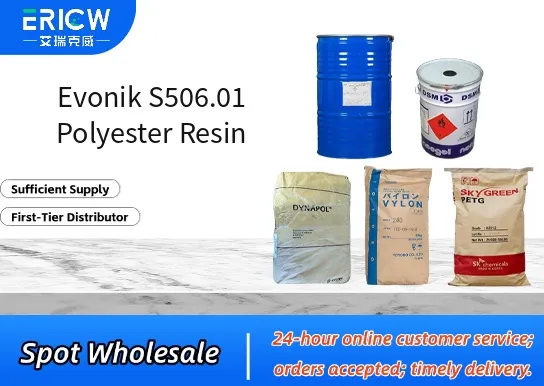
High reactivity enabling fast gel time and efficient production cycles.
Excellent mechanical strength and dimensional stability in cured composites.
Good compatibility with standard styrene monomers and common accelerators.
Low viscosity for superior fiber wet-out and improved mold filling performance.
Consistent batch-to-batch quality supported by Evonik’s stringent manufacturing controls.
Fiberglass-reinforced plastic (FRP) tanks and chemical storage vessels.
Marine components including boat hulls, decks, and structural laminates.
Wind turbine blade subcomponents and nacelle enclosures.
Automotive under-hood parts requiring thermal and chemical resistance.
Infrastructure elements such as grating, ducting, and corrosion-resistant cladding.
| Chemical Type | Unsaturated polyester resin |
| Product Form | Liquid |
| Appearance | Clear to pale yellow viscous liquid |
| Primary Applications | Hand lay-up, spray-up, and filament winding processes |
| Key Features | Fast-curing, high-strength, low-shrink formulation |
| Benefits | Enhanced productivity, excellent surface finish, and long pot life at ambient temperature |
| Styrene Content | Approx. 38–42 wt% |
| Storage Conditions | Store below 25 °C, protect from direct sunlight and moisture |
Q1: What is the primary function of Evonik S506.01 in polyester resin systems?
A: Evonik S506.01 is a specialty polyester resin designed to act as a reactive modifier or co-resin, enhancing flexibility, impact resistance, and surface hardness in unsaturated polyester formulations—particularly where improved mechanical performance and reduced brittleness are required.
Q2: Is S506.01 compatible with standard styrene-based unsaturated polyester resins?
A: Yes, S506.01 exhibits good miscibility and reactivity with conventional styrene-containing unsaturated polyesters, enabling straightforward integration into existing casting, laminating, and pultrusion formulations without requiring major process adjustments.
Q3: How does S506.01 influence gel time and cure profile?
A: S506.01 typically extends gel time slightly compared to standard resins due to its molecular structure, offering improved working time for complex molding operations—though final cure speed and degree remain fully controllable via standard peroxide initiators and ambient conditions.
Q4: Can S506.01 be used in applications requiring low shrinkage?
A: While not classified as a low-shrink additive itself, S506.01 contributes to more balanced internal stress development during cure, which—when combined with appropriate fillers and processing controls—can support reduced warpage and improved dimensional stability in finished parts.
Contact With Us:
E-mail: wangxingqiang@ericwchem.com
Have a Questions? Call Us:
Add:
Building A1, Jiete Industrial Park, Huangpu District, Guangzhou City, Guangdong Province, China