English
 Español
 tiếng việt
 русский
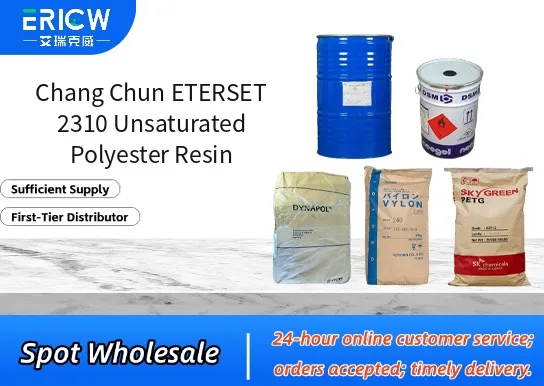
Excellent mechanical strength and dimensional stability after curing.
Good compatibility with standard MEKP initiators and low-profile additives.
Low viscosity for easy handling, impregnation, and mold filling.
Superior chemical resistance to dilute acids, alkalis, and salt solutions.
Consistent batch-to-batch performance ensured by Chang Chun’s stringent quality control.
Fiberglass-reinforced plastic (FRP) tanks and vessels for chemical storage.
Corrosion-resistant piping systems in industrial wastewater treatment.
Marine components including boat hulls, decks, and structural laminates.
Automotive body panels and under-hood composite parts.
Wind turbine blade substrates and nacelle enclosures.
| Chemical Type | Unsaturated polyester resin (orthophthalic-based) |
| Product Form | Liquid, ready-to-use |
| Appearance | Clear to pale yellow transparent liquid |
| Viscosity (25°C, mPa·s) | 250–350 |
| Gel Time (with 1.0% MEKP, 25°C) | 12–18 minutes |
| Reactive Diluent | Styrene (~38–42 wt%) |
| Solid Content (wt%) | 58–62 |
| Specific Gravity (25°C) | 1.10–1.14 |
Q1: What are the primary curing agents compatible with ETERSET 2310?
A: ETERSET 2310 is typically cured using organic peroxides such as methyl ethyl ketone peroxide (MEKP) or benzoyl peroxide (BPO), depending on the processing method and desired gel time. Catalyst selection should be optimized for ambient or elevated temperature conditions, and compatibility with fillers, pigments, and inhibitors must be verified in the final formulation.
Q2: Is ETERSET 2310 suitable for marine or corrosion-resistant applications?
A: Yes — ETERSET 2310 exhibits good chemical resistance and mechanical performance after proper curing, making it well-suited for fiberglass-reinforced plastic (FRP) components used in marine environments, chemical storage tanks, and industrial ducting. Performance depends on full crosslinking, appropriate reinforcement, and post-cure conditions.
Q3: How does ETERSET 2310 compare to general-purpose unsaturated polyester resins in terms of viscosity and handling?
A: ETERSET 2310 offers a balanced viscosity profile — low enough to ensure good wet-out of fiberglass reinforcements and ease of processing by spray-up, hand lay-up, or resin infusion, while maintaining sufficient thixotropy to minimize sagging in vertical applications. Its rheology supports consistent fiber impregnation without excessive dripping or pooling.
Q4: Can ETERSET 2310 be used in UV-exposed outdoor applications?
A: While ETERSET 2310 provides solid baseline weatherability, long-term UV resistance is enhanced when combined with UV absorbers (e.g., benzotriazoles) and HALS stabilizers, and especially when protected by gel coats or topcoats. Unprotected surfaces may undergo gradual surface chalking or gloss loss under prolonged direct sunlight.
Contact With Us:
E-mail: wangxingqiang@ericwchem.com
Have a Questions? Call Us:
Add:
Building A1, Jiete Industrial Park, Huangpu District, Guangzhou City, Guangdong Province, China