English
 Español
 tiếng việt
 русский
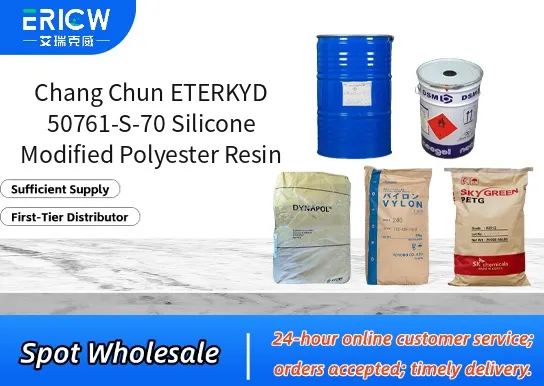
Enhanced thermal stability due to silicone modification, enabling extended service life at elevated temperatures.
Improved weather resistance and UV durability compared to conventional polyester resins.
Excellent compatibility with common crosslinkers (e.g., melamine formaldehyde) for high-performance coil and appliance coatings.
Good flexibility and impact resistance without compromising hardness or chemical resistance.
Low volatile organic compound (VOC) formulation supports compliance with stringent environmental regulations.
High-durability coil coatings for architectural and industrial metal roofing and siding.
Appliance coatings requiring long-term color retention and gloss stability.
Pretreatment-free or low-VOC pre-painted metal (PPM) systems.
Outdoor signage and transportation component coatings exposed to harsh climatic conditions.
Hybrid powder coating binders where enhanced flow and edge coverage are critical.
| Chemical Type | Silicone-modified saturated polyester resin |
| Product Form | Clear to pale yellow viscous liquid |
| Appearance | Homogeneous, transparent, free of sediment |
| Primary Applications | Coil coatings, appliance coatings, outdoor metal finishes |
| Key Features | Thermal stability, UV resistance, crosslinker compatibility, low VOC |
| Recommended Crosslinker | Melamine-formaldehyde resins (e.g., high-alkylated types) |
| Storage Stability | Stable for ≥12 months at 20–25°C in sealed containers |
| Compliance | REACH compliant; RoHS compatible |
Q1: What are the primary benefits of silicone modification in this polyester resin?
A: The silicone modification enhances thermal stability, improves surface hardness and scratch resistance, and contributes to better weatherability and gloss retention—particularly valuable in high-performance coil coating and metal finishing applications.
Q2: Is ETERKYD 50761-S-70 compatible with conventional amino crosslinkers such as melamine-formaldehyde resins?
A: Yes, it is formulated for compatibility with standard melamine-based crosslinkers commonly used in thermosetting polyester coatings. Cure profiles and final film properties should be optimized through formulation testing under intended processing conditions.
Q3: How does this resin perform in terms of flexibility and adhesion on pre-treated steel or aluminum substrates?
A: It demonstrates excellent flexibility and strong interfacial adhesion on properly cleaned and chemically treated metal substrates—especially when applied in coil coating lines where bendability and impact resistance are critical.
Q4: Can this resin be used in solvent-borne systems only, or is it suitable for low-VOC or high-solids formulations?
A: While traditionally used in solvent-borne systems, ETERKYD 50761-S-70 can be adapted into high-solids formulations with appropriate solvent selection and viscosity adjustment. Its compatibility with modern low-VOC strategies should be confirmed via lab-scale formulation trials.
Contact With Us:
E-mail: wangxingqiang@ericwchem.com
Have a Questions? Call Us:
Add:
Building A1, Jiete Industrial Park, Huangpu District, Guangzhou City, Guangdong Province, China