English
 Español
 tiếng việt
 русский
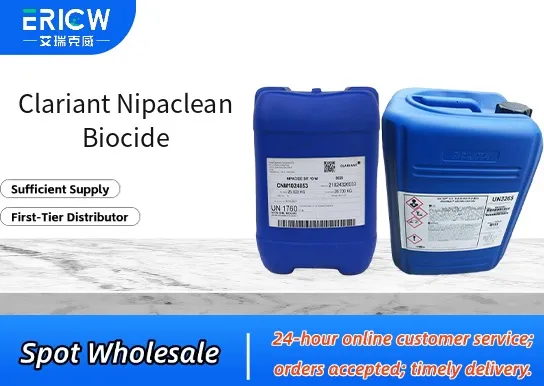
Highly effective broad-spectrum biocide against bacteria, fungi, and algae.
Compatible with common water treatment formulations and industrial process fluids.
Low toxicity profile and favorable environmental fate characteristics.
Stable across a wide pH range (pH 4–10) and tolerant to moderate temperature fluctuations.
Non-oxidizing chemistry, minimizing corrosion risk to metal and elastomer components.
Cooling water systems in power generation and HVAC installations.
Process water circuits in papermaking and pulp mills.
Recirculating water systems in metalworking fluid sumps and machining operations.
Preservation of emulsions, coatings, and water-based industrial formulations.
Control of microbial growth in closed-loop industrial water systems.
| Chemical Type | Isothiazolinone-based non-oxidizing biocide |
| Product Form | Liquid concentrate |
| Appearance | Clear, pale yellow to amber liquid |
| pH (1% aqueous solution) | 3.0–5.0 |
| Density (20°C) | Approx. 1.08–1.12 g/cm³ |
| Solubility | Completely miscible with water |
| Primary Applications | Industrial water treatment, metalworking fluids, paper mill systems |
| Key Features | Broad-spectrum efficacy, low dosage requirement, formulation stability |
Q1: What is the primary mode of action of Nipaclean Biocide?
A: Nipaclean Biocide functions as a broad-spectrum preservative through membrane disruption and interference with essential microbial metabolic processes, effectively controlling bacteria, yeasts, and molds in water-based industrial formulations.
Q2: In which types of industrial applications is Nipaclean Biocide commonly used?
A: It is widely applied in water-based coatings, adhesives, construction chemicals, metalworking fluids, and cleaning concentrates—particularly where long-term microbiological stability and low-odor performance are required.
Q3: Is Nipaclean Biocide compatible with common formulation ingredients such as surfactants and thickeners?
A: Yes, Nipaclean Biocide demonstrates good compatibility with anionic, nonionic, and amphoteric surfactants, as well as common rheology modifiers—including associative and cellulosic thickeners—under typical pH and temperature conditions encountered in industrial formulations.
Q4: How should Nipaclean Biocide be incorporated into a formulation?
A: It is typically added during the cool-down phase or post-emulsification stage to minimize thermal degradation. Dosage depends on formulation requirements but generally ranges from 0.1% to 2% by weight, with optimal levels determined through challenge testing under representative storage and use conditions.
Q5: Does Nipaclean Biocide require pH adjustment for optimal performance?
A: Nipaclean Biocide performs effectively across a broad pH range (approximately 4–10), though maximum stability and antimicrobial efficacy are typically observed between pH 5.5 and 9.0. Significant deviation outside this range may affect shelf life or activity and should be evaluated case by case.
Contact With Us:
E-mail: wangxingqiang@ericwchem.com
Have a Questions? Call Us:
Add:
Building A1, Jiete Industrial Park, Huangpu District, Guangzhou City, Guangdong Province, China