English
 Español
 tiếng việt
 русский
Advanced multi-site inhibition mode of action provides robust resistance management and broad-spectrum control against key foliar and soil-borne fungi.
Formulated with high-purity active ingredient for consistent field performance and enhanced crop safety across sensitive crops.
Excellent rainfastness and UV stability ensure prolonged residual activity under diverse climatic conditions.
Low volatility and favorable ecotoxicological profile support sustainable use in integrated pest management (IPM) programs.
Optimized for tank-mix compatibility with major herbicides, insecticides, and plant growth regulators.
Preventive and curative treatment in cereal crops including wheat, barley, and oats against rusts, powdery mildew, and septoria leaf blotch.
Foliar protection in oilseed rape (canola) targeting sclerotinia stem rot and alternaria black spot.
Control of early blight and late blight in potato and tomato production systems.
Management of anthracnose and leaf spot diseases in soybean and maize under high-humidity growing regions.
| Chemical Type | Triazole-based systemic fungicide |
| Product Form | Concentrated suspension (SC) |
| Appearance | Off-white to light beige suspension |
| Primary Applications | Foliar spray for cereals, oilseed rape, potatoes, tomatoes, soybeans, and maize |
| Key Features | Broad-spectrum efficacy, rainfastness, IPM compatibility, low mammalian toxicity |
| Benefits | Yield protection, resistance mitigation, flexible application timing, crop safety |
| Storage Conditions | Store in original container below 30°C; protect from freezing and direct sunlight |
| Shelf Life | 24 months from date of manufacture when stored as recommended |
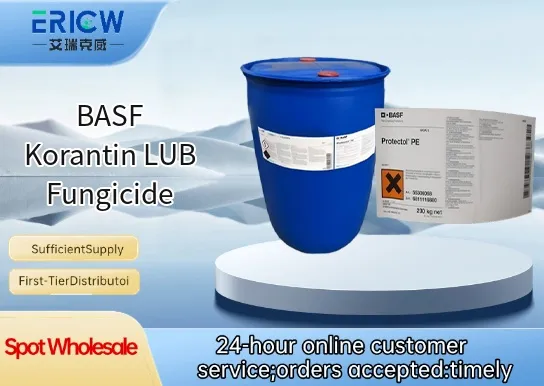
Q1: What is the primary mode of action of BASF Korantin LUB Fungicide?
A: Korantin LUB is a broad-spectrum fungicide based on a proprietary active ingredient with multi-site inhibition activity, offering robust protection against common spoilage fungi in industrial lubricants and metalworking fluids.
Q2: In which types of industrial systems is Korantin LUB typically used?
A: It is specifically formulated for use in water-miscible and semi-synthetic metalworking fluids, circulating lubricant systems, and other industrial process fluids where microbial stability—particularly against yeasts and molds—is critical to fluid life and performance.
Q3: Is Korantin LUB compatible with common biocides used in metalworking fluids?
A: Yes, Korantin LUB demonstrates good compatibility with isothiazolinones and formaldehyde donors when used at recommended treat rates; however, compatibility testing under actual formulation conditions is advised before full-scale implementation.
Q4: How should Korantin LUB be dosed in a typical metalworking fluid concentrate?
A: Dosage depends on formulation requirements and microbial challenge level, but it is generally added at low concentrations during the final stage of production—typically ranging from 0.1% to 2% by weight of the finished fluid, with optimal performance observed within the manufacturer’s validated range.
Q5: Does Korantin LUB contribute to foam control or affect emulsion stability in lubricants?
A: Korantin LUB is not designed as a defoamer or emulsifier; it has been engineered for minimal impact on foaming behavior and emulsion integrity when incorporated at recommended levels, supporting stable fluid performance over time.
Contact With Us:
E-mail: wangxingqiang@ericwchem.com
Have a Questions? Call Us:
Add:
Building A1, Jiete Industrial Park, Huangpu District, Guangzhou City, Guangdong Province, China