English
 Español
 tiếng việt
 русский
Excellent melt processability for efficient extrusion and injection molding.
Outstanding abrasion resistance and mechanical toughness at ambient and elevated temperatures.
Good low-temperature flexibility with retained elasticity down to –40 °C.
Hydrolysis-resistant aliphatic polyester-based thermoplastic polyurethane.
Compatible with common colorants and additives for tailored formulation development.
Automotive interior trim components including instrument panel skins and door panels.
High-performance industrial hoses and fluid transfer tubing.
Durable consumer electronics casings and protective overmolding.
Medical device tubing requiring biocompatibility support (ISO 10993-compliant formulations available).
Wear-resistant footwear midsoles and outsole compounds.
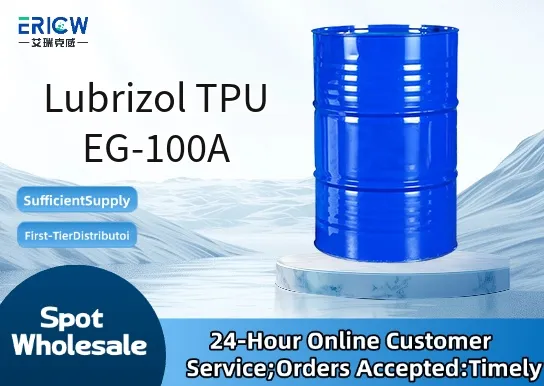
| Chemical Type | Aliphatic polyester-based thermoplastic polyurethane (TPU) |
| Product Form | Pellets |
| Appearance | Off-white to light tan, free-flowing pellets |
| Hardness (Shore A) | 95 ± 2 |
| Melt Flow Index (230 °C / 2.16 kg) | 15–20 g/10 min |
| Density | 1.18–1.20 g/cm³ |
| Primary Applications | Extrusion, injection molding, blow molding |
| Key Features | Hydrolysis resistance, UV stability, excellent tear strength |
Q1: What is the primary function of Lubrizol TPU EG-100A in thermoplastic polyurethane (TPU) formulations?
A: Lubrizol TPU EG-100A is an ethylene glycol-based chain extender designed to enhance mechanical properties—such as tensile strength, modulus, and heat resistance—in aromatic or aliphatic TPU systems. It participates directly in the polymerization reaction to build molecular weight and influence hard-segment crystallinity.
Q2: How does EG-100A compare to traditional 1,4-butanediol (BDO) in TPU synthesis?
A: EG-100A offers a lower molecular weight and higher reactivity than BDO, which can lead to faster reaction kinetics and potentially improved processability during melt polymerization. Its shorter backbone also tends to increase hard-segment polarity and may contribute to higher melting points and stiffness in the final TPU—though formulation adjustments are typically needed to balance flexibility and processing behavior.
Q3: Is EG-100A suitable for use in aliphatic TPU systems intended for light-stable or medical-grade applications?
A: Yes—EG-100A is compatible with both aromatic and aliphatic TPU systems. As a high-purity ethylene glycol derivative, it does not introduce chromophores or hydrolytically unstable linkages, supporting the development of color-stable, UV-resistant, and biocompatibility-compatible TPUs when paired with appropriate diisocyanates and polyols.
Q4: What handling and storage precautions should be observed for EG-100A?
A: EG-100A is hygroscopic and sensitive to moisture. It should be stored under dry, inert conditions—preferably under nitrogen—and kept sealed in its original container at controlled ambient temperatures. Pre-drying prior to use is recommended if exposure to humidity has occurred, to prevent side reactions and ensure consistent polymerization performance.
Contact With Us:
E-mail: wangxingqiang@ericwchem.com
Have a Questions? Call Us:
Add:
Building A1, Jiete Industrial Park, Huangpu District, Guangzhou City, Guangdong Province, China