English
 Español
 tiếng việt
 русский
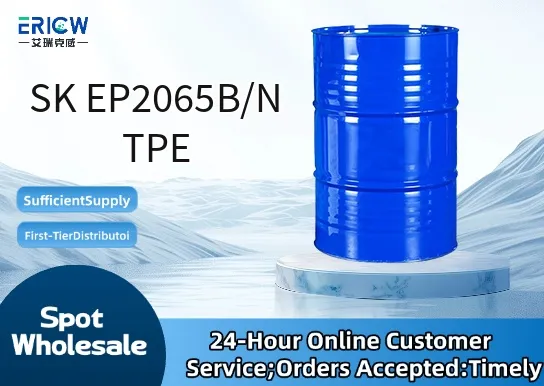
Excellent soft-touch feel with balanced elasticity and recovery.
Good processability via injection molding and extrusion without pre-drying.
Enhanced thermal stability for consistent performance across processing temperatures.
Low compression set, ensuring long-term sealing and gasketing integrity.
Compatible with polypropylene (PP) and polyethylene (PE) substrates for co-molding applications.
Automotive interior trim components including instrument panel skins and door armrests.
Consumer electronics housings and soft-grip overmolded casings.
Household appliance grips, seals, and flexible control knobs.
Medical device non-slip handles and ergonomic interfaces (non-implantable).
Industrial tool overmolding for vibration-dampening and user comfort.
| Chemical Type | Thermoplastic Elastomer (TPE) – Styrenic Block Copolymer (SBC) based |
| Product Form | Pellets |
| Appearance | Off-white to light beige, free-flowing granules |
| Hardness (Shore A) | 65 ± 3 |
| Melt Flow Rate (230°C/2.16 kg) | 18–22 g/10 min |
| Density | 0.90–0.92 g/cm³ |
| Primary Applications | Overmolding, soft-touch surfaces, dynamic seals |
| Key Features | PP/PE adhesion, low odor, RoHS compliant |
Q1: What is the primary function of SK EP2065B/N TPE in thermoplastic elastomer formulations?
A: SK EP2065B/N TPE is a functional polymer additive designed to enhance melt processability and improve surface finish in TPE compounds, particularly in styrenic (TPE-S) and olefinic (TPO/TPV) systems. It acts as a compatibilizer and flow modifier without compromising elasticity or mechanical resilience.
Q2: Is SK EP2065B/N TPE suitable for food-contact or medical-grade TPE applications?
A: While SK EP2065B/N TPE is manufactured under strict quality control and meets general industrial purity requirements, it is not pre-qualified for regulated food-contact or medical applications. End users must conduct full regulatory evaluation—including extraction testing and compliance verification—within their specific formulation and processing conditions.
Q3: How should SK EP2065B/N TPE be incorporated into TPE masterbatches or final compounds?
A: It is typically introduced during the compounding stage via twin-screw extrusion, either as a neat pellet or pre-diluted in a carrier resin. For optimal dispersion, feed it downstream of base polymer melting and ensure adequate residence time and shear history. Pre-drying is not required under standard ambient handling conditions.
Q4: Does SK EP2065B/N TPE affect the hardness or tensile properties of the final TPE compound?
A: At typical use levels, it has minimal impact on Shore A hardness or ultimate tensile strength. Its main influence is on dynamic mechanical behavior—such as improved elongation recovery and reduced permanent set—especially after repeated flexing or thermal cycling.
Contact With Us:
E-mail: wangxingqiang@ericwchem.com
Have a Questions? Call Us:
Add:
Building A1, Jiete Industrial Park, Huangpu District, Guangzhou City, Guangdong Province, China